
Using airis:protect to Check AI-Generated vs. Real Image Datasets
How AI-powered image verification can help organizations analyze image datasets, identify synthetic content, improve data quality, and strengthen trust in an increasingly AI-generated visual world
The rapid development of generative artificial intelligence has fundamentally changed the way images are created, distributed, and consumed. From photorealistic portraits and product images to marketing materials, social media content, and synthetic training datasets, AI-generated images are becoming increasingly difficult to distinguish from authentic photographs.
This development creates new opportunities, but it also introduces significant challenges for companies, researchers, online platforms, content providers, and organizations that depend on trustworthy image data. One of the most important questions is simple: Is an image real, or was it generated or significantly manipulated by artificial intelligence?
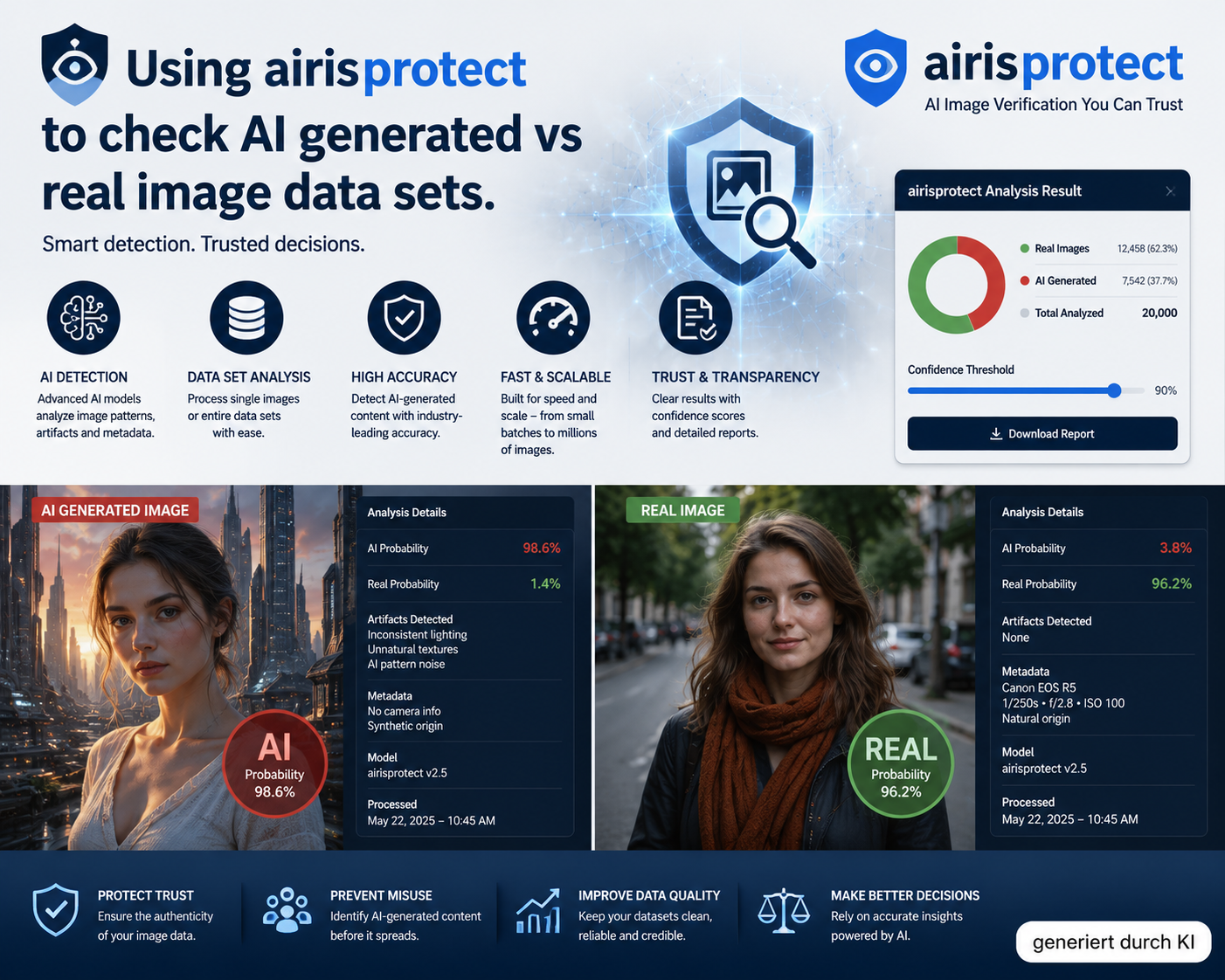
This is where AI-powered image analysis solutions such as airis:protect can play an important role. Using airisprotect to check AI-generated vs. real image datasets can provide organizations with an additional layer of analysis when evaluating the origin, characteristics, and consistency of visual content.
Rather than relying exclusively on manual inspection, organizations can use automated image analysis to process individual images or larger datasets and identify characteristics that may indicate synthetic generation or manipulation.
Why Checking AI-Generated vs. Real Image Datasets Matters
Image datasets are increasingly important across a wide range of industries. Machine learning systems, computer vision applications, online marketplaces, advertising platforms, social networks, media organizations, and research institutions all depend on image data.
The quality and origin of this data can have a significant impact on the reliability of downstream applications.
A dataset containing a mixture of real photographs, AI-generated images, manipulated photographs, and synthetic variations may introduce uncertainty. If the distinction between authentic and synthetic content is important to the intended application, organizations need appropriate methods for assessing the dataset.
For example, a company developing a computer vision system may want to understand whether its training images originate from cameras, digital editing tools, or generative AI systems. A marketplace may want to analyze whether product images are authentic representations or synthetic visuals. A media organization may want additional information about the provenance of submitted photographs.
Using airis:protect to check AI-generated vs. real image datasets can support these processes by providing automated analysis that complements human review.
The Growing Challenge of AI-Generated Images
Generative AI technology has evolved rapidly. Modern image-generation systems can produce highly realistic photographs containing people, environments, objects, products, and complex scenes.
Older AI-generated images often contained obvious visual inconsistencies. Typical examples included unnatural hands, distorted text, unrealistic reflections, or unusual facial features. However, many newer generation systems produce images that can appear convincing even to experienced observers.
This makes visual inspection alone increasingly difficult.
An image may look completely authentic while containing subtle characteristics associated with synthetic generation. These characteristics can include unusual textures, inconsistent lighting, artificial patterns, image-level artifacts, or metadata characteristics.
Consequently, organizations increasingly need automated approaches for analyzing large collections of visual data.
What Is an AI Image Dataset Check?
An AI image dataset check involves analyzing images to determine whether their characteristics are more consistent with authentic photography, AI-generated content, or potentially manipulated visual material.
A modern image verification workflow can consider multiple signals rather than relying on a single visual characteristic. Check also airis:ident for more options on verification.
Depending on the implementation, these signals may include:
- Image-level visual patterns
- Compression characteristics
- Texture consistency
- Lighting and shadow relationships
- Facial and object structures
- Digital artifacts
- Metadata where available
- Indicators associated with synthetic image generation
- Statistical characteristics within image pixels
- Similarity and consistency across a dataset
The goal is not necessarily to claim absolute certainty for every image. Instead, an AI image checker can provide analytical indicators and confidence assessments that help organizations make better-informed decisions.
This distinction is important because AI-generated image detection remains a continuously evolving field. As generative models improve, detection technologies must also evolve.
How airis:protect Can Support Image Dataset Analysis
airis:protect can be positioned as an AI-powered image analysis solution for organizations that need to examine visual content at scale.
One of the potential applications is the analysis of datasets containing both authentic and AI-generated images. Instead of manually opening thousands of images and attempting to identify synthetic content, an automated workflow can process images systematically. This can make it easier to identify images that require additional investigation.
A typical workflow could involve several stages.
a) Image Collection
The first stage is collecting the images that need to be analyzed.
These images could come from an internal database, an online platform, a marketplace, a content-management system, a research dataset, or another digital source.
The more clearly the organization defines the purpose of the analysis, the easier it becomes to establish appropriate verification criteria.
b) Automated Image Analysis
The selected images can then be processed through an AI-based analysis system.
The system evaluates relevant visual characteristics and searches for patterns that may be associated with synthetic image generation or manipulation.
This automated approach is particularly useful when dealing with large datasets.
c) Classification and Confidence Assessment
Images can subsequently be categorized according to the results of the analysis.
For example, an organization might create internal categories such as:
- Likely authentic
- Potentially AI-generated
- Potentially manipulated
- Requires human review
- Insufficient evidence
This type of classification can help teams prioritize their resources.
d) Dataset-Level Reporting
The results can also be considered at dataset level.
Instead of asking only whether one particular image is authentic, an organization can ask broader questions:
- What percentage of this dataset appears to contain AI-generated images?
- Are synthetic images concentrated in a particular source or category?
- Are there significant differences between datasets?
These insights can become valuable for quality assurance, research, moderation, and risk management.
Why Dataset-Level Analysis Is Important
Checking individual images is useful, but dataset-level analysis can provide an entirely different perspective.
Imagine an organization receives 100,000 product images from different suppliers. A manual review of every image would be extremely time-consuming. An automated image-analysis workflow can help identify patterns across the entire collection.
For example, one supplier's dataset might contain predominantly conventional photographs, while another dataset could contain a significant amount of synthetic imagery. This information may not automatically mean that one dataset is better or worse. AI-generated images can be useful and legitimate in many contexts. However, understanding the composition of the dataset allows organizations to make more informed decisions.
This is particularly important when the intended purpose of the dataset requires authentic photographic information.
AI-Generated Images Are Not Necessarily Bad
It is important to emphasize that detecting AI-generated content does not automatically mean that the content is inappropriate, fraudulent, or low quality. Synthetic images can have many legitimate applications.
Companies may use generative AI to create advertising concepts, illustrations, prototypes, fictional characters, product concepts, training materials, or creative campaigns. Researchers may intentionally use synthetic images to augment datasets.
The purpose of an AI image checker should therefore not simply be to "block AI." Instead, the purpose should be transparency and informed decision-making.
Using airis:protect to check AI-generated vs. real image datasets can help organizations understand what type of visual data they are dealing with and apply their own policies accordingly.
Improving Data Quality with AI Image Verification
Data quality is becoming one of the most important issues in artificial intelligence.
Machine learning systems learn from data. If the underlying dataset contains unexpected characteristics, those characteristics can potentially influence the resulting model. For this reason, organizations increasingly focus on data governance and dataset documentation.
AI image verification can become one component of a broader data-quality strategy. Before a dataset enters a machine learning pipeline, organizations could analyze its composition and identify potentially synthetic or manipulated images.
This can support processes such as:
- Dataset quality assurance
- Training-data evaluation
- Image provenance assessment
- Content moderation
- Research validation
- Marketplace verification
- Media verification
- Brand protection
- Digital asset management
The objective is not necessarily to eliminate synthetic content but to make its presence visible.
Protecting the Integrity of Training Data
Training datasets represent one particularly important application. AI developers increasingly use enormous collections of images to train computer vision and machine learning systems. As synthetic images become more common online, it can become difficult to determine exactly how much AI-generated content has entered a dataset.
This creates an important data-governance question. If a company intends to train a model primarily on authentic photographs, it may want to identify potentially synthetic images before training begins. Conversely, if synthetic data is intentionally included, the organization may want to document its presence.
Using airis:protect as part of a dataset verification workflow can therefore help organizations establish greater transparency around their image collections.
Supporting Content Moderation and Trust & Safety
AI-generated imagery also creates challenges for online platforms.
Social networks, dating platforms, marketplaces, advertising platforms, and content-sharing services may receive enormous volumes of visual material every day. Some synthetic images are harmless and creative. Others may be misleading, deceptive, impersonating, or used to manipulate users.
An image verification system can provide an additional signal for trust and safety teams. For example, a platform might combine AI-generated image detection with:
- Identity verification like airis:ident
- Image moderation and Text moderation
- Fraud detection
- Duplicate-image detection
- User behavior analysis
- Account verification ans also
- Human moderation
This creates a more comprehensive approach to digital trust.
Combining AI Detection with Human Review
No automated image-analysis system should be treated as an infallible replacement for human judgment.
AI-generated image detection is a complex and rapidly changing technological field. New generative models can introduce new visual characteristics, while image editing and compression can alter the signals available to detection systems. For high-impact decisions, organizations should therefore consider a human-in-the-loop approach. An automated system can identify images that require attention. Human reviewers can then investigate the most relevant cases.
This creates an efficient division of responsibilities: AI handles scale. Humans handle context.
For large datasets, this approach can dramatically reduce the amount of material requiring manual examination.
Privacy and Responsible Image Analysis
Privacy should also be considered when implementing image verification. Organizations processing images should establish clear rules concerning data storage, access, retention, security, and lawful processing. Particular attention may be necessary when datasets contain identifiable individuals or sensitive visual information.
An effective implementation should therefore combine technical capabilities with appropriate privacy and governance practices. Organizations should also clearly define why images are being analyzed, how results are used, and who has access to the information. Responsible AI image verification is not simply a technical problem. It is also a question of governance and accountability.
The Role of Metadata in Image Verification
Metadata can sometimes provide useful information about an image. Camera information, software identifiers, timestamps, editing history, and other embedded data can contribute to an investigation.
However, metadata should not be treated as definitive proof of authenticity. Metadata can be removed, modified, lost during file conversion, or changed by image-processing software. For this reason, metadata analysis is most useful when combined with other image-level signals.
An AI-powered solution such as airisprotect can therefore form part of a broader verification process rather than relying on a single indicator.
AI Image Verification for Marketplaces
Online marketplaces represent another area where AI-generated vs. real image analysis can be valuable.
Product photography plays an important role in e-commerce. Customers often use images as a primary source of information when deciding whether to purchase an item. Synthetic images can have legitimate applications, such as visualizing furniture in a room or presenting conceptual product designs. However, problems can arise when generated images create an inaccurate representation of a product.
Automated image analysis can help platforms develop additional verification signals. Combined with seller verification, product information checks, image moderation, and fraud-prevention systems, image analysis can contribute to greater marketplace transparency.
Supporting Media and Publishing Organizations
Journalists, publishers, and content platforms also face growing challenges around synthetic imagery.
AI-generated photographs can be created in seconds and distributed through social media and other digital channels. For publishers, understanding the origin of submitted visual material can be important for editorial processes. An automated verification tool cannot replace journalistic investigation, but it can provide another analytical signal.
This can help editorial teams prioritize images that require closer examination.
Scalability Is a Major Advantage
One of the strongest arguments for AI-based image verification is scalability.
A human reviewer might be able to analyze a limited number of images in detail. An automated system can potentially process substantially larger datasets. This makes AI particularly relevant to organizations operating large digital platforms. Consider a company managing millions of images.
A realistic verification strategy cannot depend exclusively on manual review. Instead, automated analysis can be used to screen content and identify cases where additional attention is appropriate.
This combination of automation and human expertise can create a more scalable operational model.
Building a Transparent AI Image Verification Strategy
Organizations considering airisprotect or another AI image checker should establish clear objectives before implementing the technology.
Important questions include:
- Why are we checking our images?
- Do we need individual-image analysis or dataset-level analysis?
- What types of synthetic content are relevant to our business?
- How should uncertain results be handled?
- When should human reviewers become involved?
- How will analysis results be stored and documented?
- What privacy requirements apply?
- How frequently should detection systems be updated?
Answering these questions helps ensure that image verification becomes part of a meaningful process rather than simply another technical tool.
The Future of AI-Generated vs. Real Image Detection
The distinction between real and AI-generated imagery will become increasingly complicated.
Generative models are improving rapidly. At the same time, images can pass through multiple editing tools, social networks, compression systems, and content-management platforms before reaching their final destination. This means that future image verification will likely require multiple analytical signals and increasingly sophisticated models. The concept of image provenance may also become more important.
Instead of asking only, "Is this image AI-generated?", organizations may increasingly ask:
- Where did this image come from?
- What tools were used to create or edit it?
- Has the image been modified?
- Can its history be documented?
This broader perspective could transform image verification from a simple detection task into a comprehensive digital-content authenticity process.
Why airis:protect Can Be Part of the Solution
The growing presence of synthetic imagery means that organizations need practical tools for understanding their visual data.
Using airis:protect to check AI-generated vs. real image datasets can provide an additional analytical layer for organizations that need to assess image collections, identify potentially synthetic content, and improve visibility into their digital assets.
The greatest value comes when image analysis is integrated into a broader workflow.
For example:
Collect → Analyze → Classify → Review → Document → Monitor
This approach allows organizations to combine automated processing with human expertise and clear governance policies.
Whether the objective is dataset quality, content moderation, marketplace trust, media verification, or digital asset management, automated image analysis can help organizations operate more efficiently in an environment where synthetic content is becoming increasingly common.
Conclusion: Preparing for a World of Synthetic Visual Content
AI-generated images are no longer a niche technology. They are becoming part of everyday digital communication, marketing, entertainment, research, e-commerce, and social media.
For organizations managing large quantities of visual data, knowing whether images are likely to be authentic, synthetic, or potentially manipulated can become an important part of data governance and digital trust.
Using airis:protect to check AI-generated vs. real image datasets offers a practical concept for addressing this challenge. By combining automated image analysis with dataset-level evaluation, human review, responsible data practices, and ongoing monitoring, organizations can gain greater insight into the composition and characteristics of their visual datasets.
The goal should not be to reject artificial intelligence. Instead, it should be to understand it.
AI-generated images can be valuable, creative, and legitimate. Real photographs remain essential for many applications as well. The key is knowing what kind of data an organization has, how that data was created, and whether it is appropriate for its intended purpose.
As the boundary between real and synthetic imagery continues to become less obvious, technologies designed to analyze visual authenticity can become an increasingly important component of modern Trust & Safety, data quality, content moderation, and digital verification strategies.
For companies that want to build more transparent and reliable image workflows, AI-powered image analysis represents an important step toward a future where digital images can be evaluated not only for what they show, but also for how they were created.