

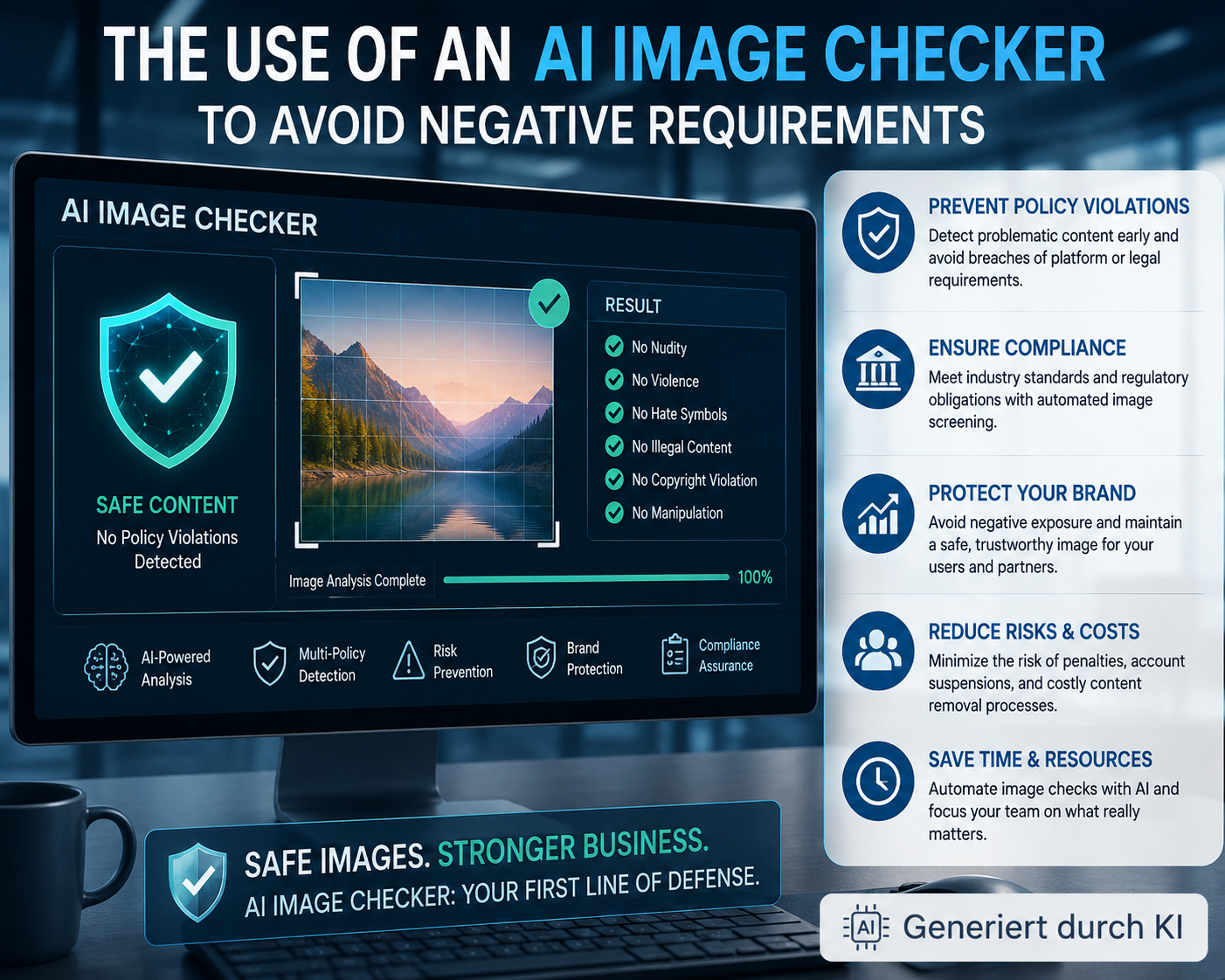
The Use of an AI Image Checker to Avoid Negative Requirements.
How AI image checkers help businesses identify problematic visual content, support compliance, reduce risk, and protect digital platforms from unwanted or prohibited images.
In today’s digital economy, images are one of the most important forms of online communication. E-commerce platforms, social networks, marketplaces, dating services, advertising portals, content platforms, forums, and business websites process millions of images every day. While visual content creates engagement and commercial opportunities, it can also introduce significant risks.
Problematic images can violate platform policies, advertising standards, community guidelines, legal requirements, brand policies, or payment provider expectations. For organizations operating at scale, manually checking every image is often impossible. This is where an AI image checker can provide valuable support.
An AI image checker uses artificial intelligence and computer vision technologies to analyze visual content and identify potentially problematic elements before images are published or distributed. The objective is not simply to remove content. Instead, modern image checking solutions can help businesses understand what an image contains, determine whether it meets predefined requirements, and route questionable content for further review.
The use of an AI image checker to avoid negative requirements can therefore become an important component of a broader content moderation, trust and safety, compliance, and brand protection strategy. Using the service of airisprotect.com could be a great benefit.
What Is an AI Image Checker?
An AI image checker is an automated technology designed to analyze digital images and identify specific characteristics, objects, scenes, or content categories.
Depending on the system and its configuration, an AI image checker may evaluate images for:
- Nudity or sexually explicit content
- Violence or graphic imagery
- Weapons
- Hate-related symbols
- Illegal or restricted content
- Self-harm-related imagery
- Drugs
- Extremist content
- Fraud indicators
- Manipulated images
- Potentially misleading visual content
- Copyright-related indicators
- Brand safety risks
- Age-related concerns
- Objects or scenes that violate platform rules
The exact capabilities depend on the AI model, training data, configuration, and business requirements.
Instead of relying exclusively on human moderators, companies can use automated image analysis as an initial screening layer. Images that clearly comply with the applicable requirements can continue through the publishing process, while images that generate a warning can be rejected, quarantined, or sent to a human reviewer.
This creates a scalable approach to AI image moderation and service like airisprotect.com and airisident.com for verfification tools.
Why Businesses Need Automated Image Checking
The volume of visual content uploaded to digital platforms continues to increase. A marketplace may receive thousands of product photographs. A social platform can process millions of user-generated images. Dating and community platforms may receive large quantities of profile pictures and user uploads.
Manually reviewing all this content presents several challenges.
Human moderators require time, training, and resources. They can also experience fatigue when reviewing repetitive or disturbing material. In addition, different moderators may interpret borderline content differently.
An AI image checker can provide a standardized first layer of analysis.
The technology can operate continuously, process large numbers of images, and apply predefined policies consistently. This does not mean that AI should replace human moderation in every situation. Instead, the most effective strategy is often a combination of automated screening and human expertise.
Understanding “Negative Requirements”
The term negative requirements can refer to visual characteristics that a business does not want to appear on its platform or within a particular service.
For example, an online marketplace may prohibit:
- Pornographic images
- Violent imagery
- Hate symbols
- Illegal products
- Misleading photographs
- Manipulated product images
- Offensive content
An advertising platform may have different requirements. It might restrict explicit imagery, dangerous products, deceptive visual claims, or content that could negatively affect advertisers and users.
The important principle is that every platform has its own definition of acceptable and unacceptable content.
An AI image checker can translate these rules into automated screening categories.
Instead of asking a human employee to examine every upload, the system can automatically assign risk scores or classifications.
AI Image Checker and Content Moderation
One of the most important applications of an AI image checker is content moderation.
AI-powered content moderation can analyze images before publication and compare them against predefined moderation policies.
A typical workflow might look like this:
Image upload → AI analysis → Classification → Risk assessment → Decision or human review → Publication
If an image receives a low-risk score, it may be automatically approved.
If the AI identifies potentially problematic content, the image can be blocked or temporarily held for review.
If the result is uncertain, the platform can send the image to a human moderator.
This approach is known as a human-in-the-loop moderation model.
It allows companies to automate straightforward decisions while preserving human judgment for complicated cases.
Protecting Brand Safety With AI Image Checking
Brand reputation is one of the most valuable assets a company owns.
An inappropriate image appearing next to a company's advertising, product, or service can create negative associations. This is especially relevant for businesses operating user-generated content platforms.
AI image checkers can help reduce the likelihood of problematic visual material reaching public pages.
For example, a platform could define a brand safety policy that identifies categories of content considered unsuitable for publication.
The AI image checker then evaluates incoming images before they become publicly visible.
This proactive approach is important.
Rather than waiting for users or advertisers to report problematic content, organizations can identify potential issues before they become public incidents.
AI Image Checker for Online Marketplaces
Online marketplaces depend heavily on user-generated images.
Sellers upload photographs of products, services, properties, vehicles, and other items. These images influence purchasing decisions and contribute to the credibility of the marketplace.
However, not every uploaded image is appropriate.
Images may contain prohibited products, offensive content, personal information, manipulated elements, or content unrelated to the advertised product.
An AI image checker can help marketplaces establish automated visual quality and safety controls.
For example, an online marketplace might use AI to identify:
- Prohibited products
- Weapons
- Drugs
- Explicit content
- Misleading images
- Duplicate images
- Inappropriate backgrounds
- Personal information
- Manipulated photographs
Automated screening can help platforms maintain consistent standards across large numbers of listings.
AI Image Checker for E-Commerce
E-commerce businesses can also benefit from automated image analysis.
Product pages often contain multiple photographs, including images uploaded by sellers, customers, manufacturers, and marketing teams.
An AI image checker can help determine whether visual content complies with internal publishing standards.
For example, companies can establish rules concerning:
- Product presentation
- Explicit imagery
- Logos and trademarks
- Unsafe products
- Offensive visual material
- Misleading representations
- Image manipulation
- Prohibited objects
This can support both customer trust and operational efficiency.
AI Image Checking and Fraud Prevention
Images are increasingly used in fraudulent activities.
Fake profiles, manipulated documents, counterfeit products, misleading listings, and stolen photographs can all create problems for digital platforms.
AI image analysis can identify certain visual signals associated with suspicious content.
Advanced systems may analyze image characteristics, metadata where available, visual inconsistencies, manipulation indicators, or similarities between images.
However, organizations should avoid treating AI detection as absolute proof of fraud.
AI should generally produce an assessment or risk signal rather than automatically accusing a user of fraudulent behavior without additional evidence.
Combining AI image analysis with identity verification, behavioral analysis, document verification, and human review can create a stronger fraud prevention strategy.
The Role of Computer Vision
The technological foundation of many AI image checkers is computer vision.
Computer vision enables software systems to interpret visual information.
Modern computer vision models can detect objects, recognize patterns, classify scenes, and identify specific visual characteristics.
For content moderation, this means an AI system can examine an image and estimate whether it belongs to particular categories.
For example, the system might recognize that an image contains:
Person + vehicle + outdoor scene + potentially restricted object
The platform can then compare those findings with its moderation rules.
This creates a connection between visual recognition and business policy.
AI Image Checker and Regulatory Compliance
Digital businesses increasingly need to consider legal and regulatory requirements when managing user-generated content.
The exact obligations vary according to jurisdiction, industry, service type, and the nature of the content being processed.
An AI image checker can support compliance processes by creating a systematic first-level screening mechanism.
However, companies should not assume that AI automatically guarantees legal compliance.
Technology is a tool. Businesses remain responsible for understanding the regulations applicable to their operations and implementing appropriate governance procedures.
A responsible compliance framework should consider:
- Applicable laws
- Industry requirements
- Data protection
- User rights
- Content policies
- Moderation procedures
- Documentation
- Auditability
- Human oversight
AI can support these processes, but it should operate within a broader governance framework.
Privacy and Responsible AI Image Analysis
Image moderation can involve personal information. Consequently, privacy should be considered from the beginning of the system design.
Businesses should determine:
- What information must be analyzed?
- What information needs to be stored?
- How long should results be retained?
- Who can access moderation data?
- Can unnecessary data be deleted?
- How are users informed?
- How are false positives handled?
The principle of data minimization is particularly relevant.
An organization should avoid collecting or retaining information that is not necessary for its stated purpose.
Privacy-conscious AI image checking can therefore help businesses balance security with responsible data handling.
Reducing False Positives
One of the major challenges in automated image moderation is the false positive.
A false positive occurs when an AI system identifies content as problematic even though it actually complies with the applicable rules.
For example, an educational image, medical photograph, artwork, or historical photograph might be incorrectly classified as inappropriate.
This is why a simple “allow or block” system is not always sufficient.
More sophisticated moderation architectures can use confidence scores.
For example:
- Low risk: Automatically approve
- Medium risk: Send to human review
- High risk: Temporarily block or quarantine
This approach allows organizations to focus human resources on cases where human judgment provides the greatest value.
Reducing False Negatives
False negatives present the opposite problem.
A false negative occurs when problematic content passes through an automated system.
This can be particularly damaging when the content violates important platform rules or legal requirements.
Companies should therefore continuously evaluate the performance of their AI image checker.
Important metrics can include:
- Precision
- Recall
- False-positive rate
- False-negative rate
- Processing speed
- Human-review rate
- Detection accuracy
Regular testing can help organizations identify weaknesses and improve moderation policies.
Combining AI With Human Moderators
The strongest approach is often not AI versus humans, but AI plus humans.
AI systems are excellent at processing large volumes of information quickly. Human moderators are better equipped to understand context, ambiguity, cultural differences, and unusual circumstances.
A hybrid moderation system can therefore provide several advantages.
AI performs the first screening.
Human moderators handle uncertain or sensitive cases.
The resulting decisions can also provide feedback for improving the moderation process.
This creates a continuous improvement cycle.
AI Image Checker as a Proactive Business Tool
One of the biggest advantages of automated image checking is that it moves content moderation from a reactive process to a proactive process.
Without automated screening, a company may discover problematic content only after:
- A customer complains
- An advertiser raises an issue
- A payment provider asks questions
- A regulator becomes involved
- The content goes viral
- A journalist reports it
- Other users flag it
With an AI image checker, organizations can identify many potential problems before publication.
This can reduce operational risk and improve trust.
Choosing the Right AI Image Checker
Not every AI image checker is suitable for every organization.Before selecting a solution, businesses should evaluate several factors. These could be:
Detection Capabilities: Does the system identify the categories relevant to the company's platform?
Accuracy: How well does the solution handle false positives and false negatives?
Scalability: Can the system process the organization's expected image volume?
Integration: Can it integrate with existing websites, applications, APIs, content management systems, or moderation workflows?
Privacy: How is user data handled, processed, and stored?
Customization: Can businesses define their own rules and risk thresholds?
Human Review: Does the solution support escalation to human moderators?
Reporting: Can the company document decisions and generate useful moderation statistics?
These factors should be evaluated before implementing automated image moderation.
The Business Benefits of AI Image Checking
When properly implemented, an AI image checker can provide several business advantages. On overview is here:
Greater Efficiency: Automated analysis reduces the amount of routine content that requires manual review.
Faster Moderation: Images can be analyzed within seconds or faster, depending on the infrastructure.
Improved Scalability: Platforms can process large volumes of content without increasing moderation teams at the same rate.
Better Brand Protection: Organizations can proactively reduce the publication of inappropriate visual material.
Lower Operational Costs: Automation can reduce the amount of repetitive manual work.
Consistent Enforcement: AI can apply predefined rules consistently across large quantities of content.
Improved User Trust: Users are more likely to trust platforms that actively maintain clear safety standards.
The Future of AI Image Checkers
The role of AI image checkers is likely to expand as digital platforms continue to rely on visual content.
Future systems are expected to become increasingly sophisticated in understanding context rather than simply identifying individual objects.
Instead of recognizing only what appears in an image, AI systems may increasingly analyze the relationship between:
Image + text + user behavior + account history + platform policy
This multimodal approach could improve the ability to distinguish legitimate content from content that presents a genuine risk.
For example, the same image may be acceptable in an educational context but inappropriate in an advertising environment. Context can therefore become as important as visual recognition.
AI Image Checking Is About Prevention, Not Just Blocking
The phrase “AI image checker” can sometimes create the impression that the technology exists solely to block images.
In reality, its purpose can be much broader.
AI image analysis can help businesses:
- Understand visual content
- Assess risk
- Support compliance
- Protect users
- Protect brands
- Improve moderation efficiency
- Detect suspicious material
- Support human moderators
- Create consistent publishing standards
The objective should be to create a safer and more reliable digital environment rather than simply maximizing the number of blocked images.
Conclusion
The use of an AI image checker to avoid negative requirements with services like the one from airisprotect.com or airisident.com is becoming increasingly relevant for businesses that depend on user-generated and visual content.
As online platforms grow, manually reviewing every image becomes increasingly difficult. AI-powered image checking offers a scalable way to analyze visual content, identify potentially problematic material, and support predefined safety, compliance, and brand protection requirements.
The technology can be particularly valuable for e-commerce platforms, marketplaces, social networks, dating services, advertising platforms, content providers, and other businesses that process large quantities of images.
However, successful implementation requires more than simply connecting an AI model to an upload form.
Organizations need clear policies, appropriate risk thresholds, privacy safeguards, performance monitoring, human oversight, and transparent processes for handling uncertain cases.
The most effective strategy is therefore a balanced one: use AI for speed and scale, while using human expertise for context and accountability.
An AI image checker should not be viewed as a replacement for responsible governance. Instead, it should become one component of a comprehensive AI content moderation and trust and safety strategy.
By checking images before they create problems, businesses can move from reactive content management toward proactive risk prevention. This can help protect users, strengthen brands, improve operational efficiency, and create a more trustworthy digital environment.
In an internet economy where visual content plays an increasingly central role, organizations that invest in intelligent and ethical image verification can gain an important advantage: the ability to identify potential risks before those risks become costly problems.