
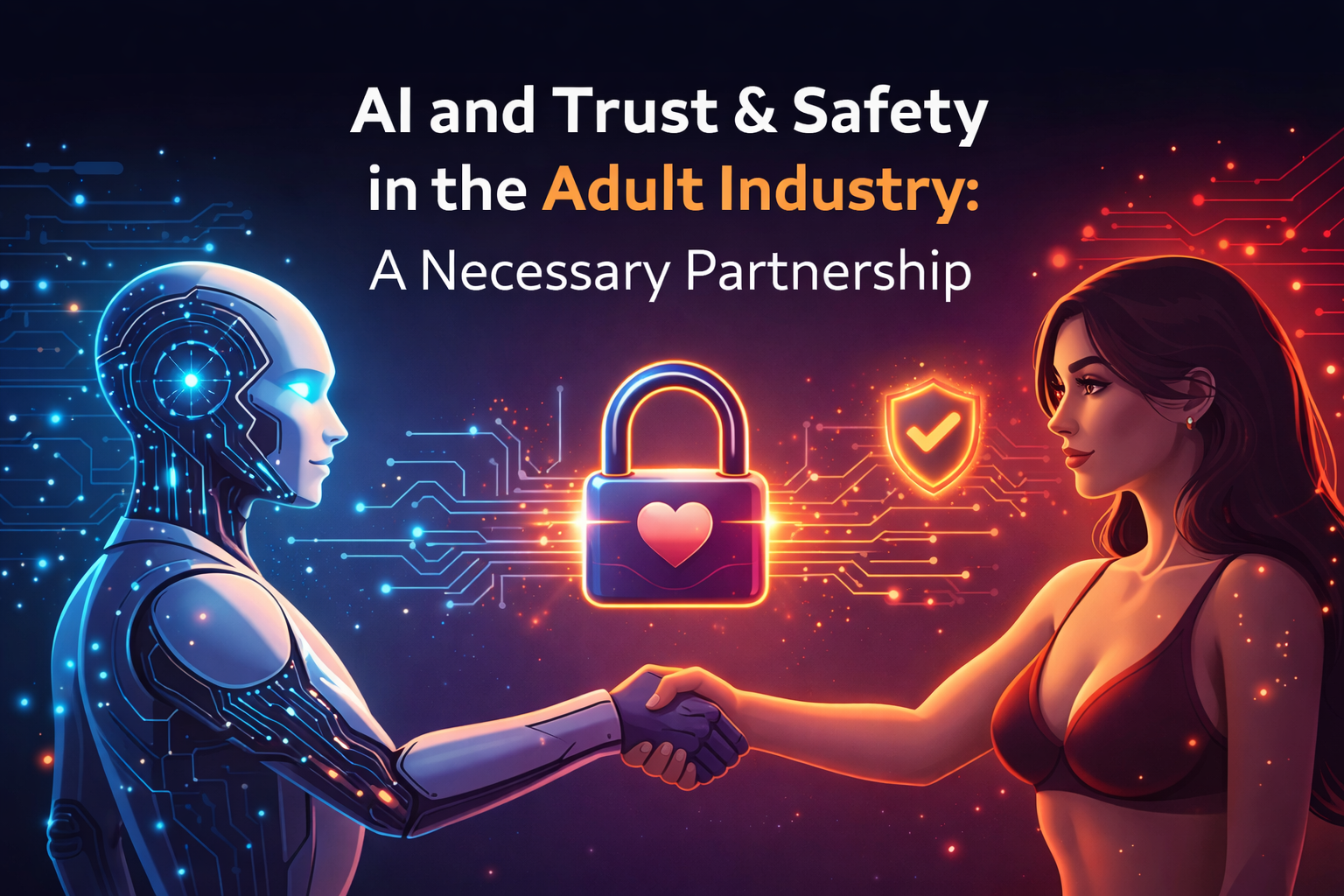
Trust & Safety (T&S) in the adult industry is both high-stakes and complex.
As digital platforms continue to reshape the adult entertainment industry, Trust & Safety (T&S) has emerged as one of its most critical and scrutinized functions. From preventing the spread of non-consensual content to protecting minors and combating exploitation, adult platforms face a uniquely complex set of challenges. Increasingly, artificial intelligence (AI) is being positioned as a powerful ally, but not a standalone solution.
Balancing legal compliance, user protection, consent verification and platform integrity, often under stricter scrutiny than other sectors. AI can absolutely support this space, but it needs to be deployed thoughtfully, with strong human oversight.
Check the breakdown of where AI helps, where it struggles, and how to use it responsibly with the Key Trust & Safety Challenges in Adult Business:
Adult platforms like content sites, cam servicesor dating apps typically face topics of
- Consent verification (especially for uploaded content)
- Non-consensual content (revenge porn, leaks)
- Age verification & minor protection
- Content moderation at scale
- Payment fraud & scams
- User harassment and abuse
Manual moderation alone doesn’t scale these areas.
So the question is: Where AI Can Support Effectively? Let’s find out.
First view is the Content Moderation for Image, Video and Text and scaling safety in a High-Risk Environment.
Machine learning systems can analyze images, videos, and text in real time, helping platforms identify potentially harmful content before it spreads widely. In chat environments, AI can flag illegal or non-consensual patterns associated with grooming, coercion, or harassment, enabling faster intervention and detect nudity and explicit content (baseline classification). Also identify deepfakes or manipulated media.
This is already widely used to triage content before human review, not replace it.
Unlike many other digital sectors, adult platforms must navigate heightened legal, ethical, and societal expectations. The sheer volume of user-generated content makes manual moderation alone impractical. AI offers a way to scale safety operations automatically.
Secondly the use of Age & Identity Verification is a point:
AI-powered systems are able to analyze IDs for authenticity and perform facial age estimation (with caution) as well as detect mismatches between ID and uploaded content. That means AI should assist, not be the sole decision-maker due to error risk. AI is also being deployed in age and identity verification processes. Advanced systems can scan IDs for authenticity, compare facial features, and flag discrepancies.
However, experts caution that such technologies should support - not replace - human judgment, especially given the risks of false positives and bias.
As a third point the behavioral Risk Detection should be reflected:
Machine learning can identify suspicious upload patterns, e.g., mass uploads or stolen content. Also fraudulent accounts or bot activity and sure signals of coercion like unusual account control patterns.
Next is the proactive Harm Detection where AI can surface Keywords or patterns linked to trafficking or exploitation. Repeat offenders across accounts and known illegal content via hashing, e.g., fingerprint databases.
Another view are the scalable Moderation Workflows. AI helps to prioritize high-risk content and reduces moderator workloads or speed up response times for reports.
After the review oft hat topics we nee to watch the other side oft he moon and figure out where AI falls short.
AI is not reliable enough alone for Consent Detection as the AI cannot truly determine if all participants have consented. The AI might also have issues with Context Understanding in Satire, roleplay or consensual kink can be misclassified.
Consent remains one of the most difficult areas for automation. While AI can identify known illegal content through hashing technologies or flag suspicious uploads, it cannot definitively determine whether all participants in a video have given informed consent. This limitation underscores the continued importance of human moderators.
Another issues are Bias & Errors as age, ethnicity and body-type bias in models. Here the challenge is in the a) False positives with unfair bans or b) False negatives with missed harm.
And finally the Legal Nuance is difficult, because laws differ widely by country (e.g., EU vs US vs UK)
A good advise and best practice should be something like a Human + AI Hybrid Model. Here the most effective T&S systems use Layered Approach in AI filtering (first pass), then do a risk scoring, integrate the human moderation for final decisions and appeals the process.
This layered model not only improves efficiency but also reduces the psychological burden on moderators by limiting their exposure to the most extreme content.
But don’t forget the human Oversight is critical, especially for edge cases (consent, exploitation) and the moderator training is essential and a must have.
In all the pros and conas for sure the Governance & Compliance Considerations are essential to look at.
Means if you're operating in Europe (like Germany), you must align with the Digital Services Act (DSA) – platform accountability & moderation transparency as well as General Data Protection Regulation (GDPR) – handling biometric and identity data. You’ll find age verification laws that are increasingly strict across EU and therefor the AI systems must be transparent, auditable and privacy-conscious.
In a nutshell my strategic Recommendations if you’re building or improving T&S in an adult business looks like that:
Use AI for detection, triage, prioritization and pattern recognition at scale.
Keep humans fort he final decisions, appeals and sensitive cases.
Invest in clear policies for consent, age or content rules and invest in user reporting tools. Moderator wellbeing (this work is intense) is important.
Add safeguards with regular model audits, Bias testing and explainability where possible.
There are also concerns about surveillance and data protection, especially when biometric technologies are involved. Striking the right balance between safety and privacy remains an ongoing challenge.
So, we could state as the Bottom Line that AI is a powerful amplifier for Trust & Safety in the adult industry—but not a replacement for human judgment. The safest and most effective systems combine automation + human expertise + strong governance.
As the adult industry continues to evolve, so too will its approach to Trust & Safety.
AI will play an increasingly central role, but its effectiveness will depend on how well it is integrated with human oversight, clear policies, and regulatory compliance.
Stay tuned with airis:protect.