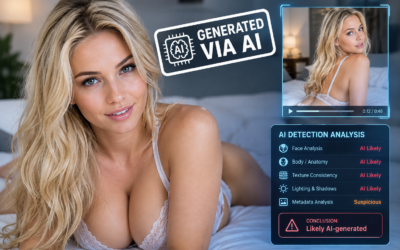


Why Digital Image Verification Matters
Digital images have become one of the most influential forms of communication in modern society. Businesses use visual content to promote products, online marketplaces rely on photographs to present goods, artists publish digital artwork, and social media platforms depend on images to attract and engage audiences. At the same time, artificial intelligence has fundamentally changed how digital images are created, edited, distributed, and reproduced.
Today, sophisticated generative AI tools can produce realistic portraits, landscapes, illustrations, advertising visuals, product photographs, and complex artistic compositions within seconds. These technologies offer enormous creative opportunities, but they also introduce new challenges for businesses, publishers, artists, and online communities.
How can users determine whether an image was created by artificial intelligence? Can a digital photograph be trusted as an authentic representation of a real event? Has an image been manipulated, copied, or presented in a misleading context? And how can organizations evaluate thousands of visual submissions without relying entirely on manual inspection?
An AI art scanner can help address these questions by analyzing digital images and identifying characteristics that may indicate AI generation, image manipulation, or other forms of digital alteration.
Depending on its capabilities, an AI art scanner may examine visual patterns, image structures, metadata, compression characteristics, and other technical signals. The results can support decisions about authenticity, content moderation, intellectual property protection, and visual quality control.
However, reliable image verification requires more than a simple automated classification. AI detection systems have limitations, and no single method can guarantee that every image is correctly identified.
For businesses that depend on trustworthy visual content, understanding how an AI art scanner works—and how to use it responsibly—is becoming increasingly important.
What Is an AI Art Scanner?
An AI art scanner is a software solution designed to analyze digital artwork or other visual content and identify characteristics relevant to its origin, authenticity, composition, or modification history.
The exact functionality depends on the technology behind the tool. Some systems focus specifically on distinguishing AI-generated images from photographs or traditionally created artwork. Others analyze image quality, identify visual anomalies, detect potentially manipulated content, or support broader content verification workflows.
An AI art scanner may be used to investigate several questions:
- Was this image potentially generated using an AI image-generation model?
- Does the image contain visual inconsistencies that deserve further investigation?
- Could the image have been manipulated or altered?
- Does the image require additional review before publication or distribution?
- Does the content comply with a platform's visual content policies?
Detecting that an image may be AI-generated does not prove that it is misleading, unlawful, or harmful. Similarly, identifying an image as likely camera-produced does not establish that it has never been edited.
A useful AI art scanner should therefore be understood as an analytical tool that provides evidence and indicators, rather than an infallible authority on image authenticity.
How Does an AI Art Scanner Detect AI-Generated Images?
AI-generated images are created through computational systems trained on large collections of visual data. Depending on the model and generation technique, the resulting images may contain statistical patterns or subtle characteristics that differ from those commonly found in camera photographs or traditionally created artwork.
AI image detectors attempt to identify these characteristics using machine learning, computer vision, statistical analysis, or combinations of different methods.
Machine learning and image classification
Many AI art scanners use machine learning models trained on examples of AI-generated and non-AI-generated images.
During training, a model learns patterns that may help distinguish between different categories of images. When a new image is submitted, the model evaluates its features and produces a classification or confidence score.
The model may identify characteristics that are difficult for humans to recognize consistently.
However, its performance depends on the quality and diversity of its training data, the AI generators represented in that data, and the extent to which the submitted image differs from the examples used during development.
A detector trained on older image-generation systems may perform less reliably on images produced by newer models.
Visual pattern analysis
AI-generated images can contain subtle statistical patterns, textures, or structural characteristics associated with the methods used to create them.
An AI art scanner may analyze aspects of image texture, pixel relationships, spatial patterns, and other features learned by its detection model.
These signals are not universal. Modern generators can produce highly realistic images, while photographs can acquire unusual patterns through resizing, sharpening, compression, or editing.
Consequently, visual pattern analysis should be combined with appropriate testing and other evidence when a reliable decision is important.
Image artifacts and structural inconsistencies
Certain generated images may contain unusual details, such as inconsistent reflections, distorted small objects, irregular text, or implausible spatial relationships.
An AI art scanner may identify some of these characteristics, especially when they form part of a broader pattern.
Nevertheless, visual artifacts alone are not a reliable method for identifying AI-generated content. Human-created artwork can contain deliberate distortions, and AI systems increasingly produce convincing visual details.
Modern detection systems must therefore look beyond obvious mistakes and evaluate a broader range of signals.
AI Art Scanner vs. Traditional Image Authenticity Checker
Although the terms are sometimes used interchangeably, an AI art scanner and an image authenticity checker may serve different purposes.
An AI art scanner primarily evaluates whether an image exhibits characteristics associated with AI generation. An image authenticity checker may focus more broadly on whether an image has been altered, whether its metadata is consistent with its claimed source, or whether it can be linked to a trusted record.
Consider a product photograph submitted to an online marketplace.
An AI art scanner might indicate that the image is likely to have been generated by an AI model. An authenticity checker might inspect metadata or compare the image with a reference photograph supplied by the manufacturer.
Neither result alone necessarily establishes whether the seller is misleading customers. A retailer may legitimately use AI-generated promotional illustrations, while a genuine photograph may still show a product that differs from the item being sold.
The correct verification method depends on the question being asked.
| Verification method | Main purpose | Important limitation |
| AI art scanner | Estimates whether an image may be AI-generated | Classification can be incorrect |
| Image manipulation detection | Identifies signs of possible editing or alteration | Legitimate editing can trigger alerts |
| Metadata analysis | Examines available file information | Metadata can be removed, changed, or fabricated |
| Reverse image search | Finds visually similar or previously published images | Results may not establish original authorship |
| Provenance verification | Checks available records about an image's origin or history | Records may be absent or incomplete |
| Human visual review | Evaluates context, content, and apparent inconsistencies | Reviewers can make mistakes and may disagree |
For high-confidence decisions, businesses should select the methods that correspond to their actual verification requirements. airis:protect is a great solution for it.
Why Businesses Need AI Image Detection
The growing availability of AI-generated imagery creates both opportunities and risks for organizations that depend on visual content.
Businesses can use generative AI to develop advertising campaigns, create concept art, produce illustrations, and accelerate design processes. At the same time, they may receive images that have been generated or altered without clear disclosure.
An AI art scanner can help organizations introduce a more consistent process for evaluating these submissions.
Protecting brand credibility
Brand trust depends partly on whether customers believe the visual information presented by a company is accurate.
If an online retailer displays misleading product photographs, customers may receive goods that differ from their expectations. If a company publishes a manipulated image as documentary evidence, its credibility may suffer.
Image analysis tools can flag visual material for further review when its origin or characteristics require clarification.
However, AI-generated content is not inherently deceptive. Businesses should establish policies that distinguish permitted creative imagery from content that misrepresents real products, people, events, or experiences.
Supporting content moderation
Social networks, dating platforms, online communities, and user-generated content services process enormous volumes of images.
An AI art scanner can provide additional signals during content review, particularly when a platform wants to understand whether images may be synthetic, manipulated, or submitted in violation of its policies.
These signals can complement image moderation systems that classify content according to categories such as violence, nudity, prohibited material, or other policy-defined risks.
Importantly, these are separate functions. A scanner designed to identify AI-generated artwork does not automatically determine whether an image is safe or appropriate for publication.
Reducing manual review workloads
Manual image inspection can be expensive and difficult to scale.
Automated analysis can help prioritize images that deserve closer examination, allowing human reviewers to concentrate on uncertain or higher-risk cases.
The objective should be to improve efficiency without assuming that automated decisions are always correct.
AI Art Scanner for E-Commerce and Online Marketplaces
E-commerce is one of the industries where visual trust has a direct influence on purchasing decisions.
Customers often rely on photographs to assess product appearance, color, dimensions, condition, and quality before placing an order. Marketplace operators must also consider counterfeit goods, misleading listings, unauthorized product images, and deceptive seller behavior.
An AI art scanner can support marketplace operations by identifying images that may require additional checks.
For example, a seller might upload an image claiming to show a second-hand smartphone. If the image appears to be an AI-generated illustration rather than a photograph of the actual device, the platform may request additional photographs or review the listing more closely.
This does not mean that AI-generated images should always be prohibited. Some categories legitimately use illustrations, rendered product concepts, or AI-assisted marketing material.
Instead, marketplaces should define clear requirements for different listing categories.
A photograph presented as evidence of a used product's physical condition may require a different standard from a promotional illustration used in an advertisement.
Combining AI image analysis with duplicate-image detection, seller verification, product moderation, and reporting mechanisms can create a more comprehensive approach to marketplace trust.
AI Art Detection for Artists, Designers, and Creative Industries
Artificial intelligence has created a new environment for artists, illustrators, photographers, and digital designers.
Generative AI can help creators explore ideas, accelerate concept development, and experiment with visual styles. However, it has also raised questions about authorship, disclosure, licensing, originality, and the use of creative works in AI training.
An AI art scanner can assist with certain aspects of these discussions by evaluating whether a submitted image exhibits characteristics associated with AI generation.
For example, an online art competition may establish rules about whether generative AI is permitted. A scanner could help organizers identify submissions that warrant additional review.
A design agency may also want to understand whether a deliverable contains AI-generated components when its client has specified particular requirements concerning authorship or disclosure.
However, detector results should not be treated as definitive proof of who created an image or whether copyright has been infringed.
AI-assisted artwork can involve substantial human input, and traditionally created work may be digitally processed in ways that affect detection results. Legal questions about copyright, training data, ownership, and infringement require evidence and jurisdiction-specific analysis.
For this reason, AI art scanning works best as one part of a transparent creative workflow that may also include disclosure requirements, licensing documentation, project records, and human assessment.
Detecting Manipulated Images, Deepfakes, and Misleading Visual Content
Not all digital image risks involve fully AI-generated artwork.
Images may be manipulated through traditional editing software, face replacement, compositing, generative fill, or other techniques that change the meaning of the original material.
In some cases, altered images are distributed to impersonate individuals, misrepresent events, damage reputations, or support fraudulent claims.
An AI art scanner may identify some characteristics associated with synthetic image generation, but it should not automatically be considered a comprehensive deepfake detector.
Different forms of manipulation leave different technical traces, and some editing processes may remove or obscure those traces.
Organizations concerned about manipulated content should consider a broader set of tools, including:
- Image manipulation analysis.
- Face or object consistency checks where appropriate.
- Reverse image search and reference-image comparison.
- Metadata and provenance inspection.
- Trusted-source verification.
- Contextual review by trained personnel.
For example, a news organization reviewing a photograph associated with a breaking event should consider where the image originated, whether the original source can be identified, and whether independent evidence supports the claimed context.
A detector score alone cannot establish that an event occurred as depicted.
The central principle is that image authenticity depends on more than visual appearance. Source information, context, corroborating evidence, and a documented verification process can all be important.
How to Interpret AI Art Scanner Results Correctly
One of the most important aspects of AI image detection is understanding what the result actually means.
Many tools provide a classification, a probability-like score, or a confidence indicator. These outputs are not necessarily equivalent to the real-world probability that an image was generated by AI.
The meaning of a score depends on the model, its calibration, the data used for evaluation, and the prevalence of AI-generated content in the target environment.
Two major error categories deserve particular attention.
False positive: A genuine photograph or human-created artwork is incorrectly classified as AI-generated.
False negative: An AI-generated image is incorrectly classified as authentic or non-AI-generated.
Both errors can have significant consequences.
A false positive could unfairly damage an artist's reputation or cause a legitimate marketplace listing to be rejected. A false negative could allow misleading imagery to pass through a verification process.
Organizations should evaluate their tolerance for each type of error before deciding how to use detection results.
For low-risk applications, a scanner may be sufficient to support a general content analysis workflow. For high-impact decisions, such as disciplinary action, fraud allegations, or consequential eligibility decisions, additional evidence and appropriate human review are particularly important.
A responsible implementation should also communicate uncertainty rather than presenting every classification as an unquestionable fact.
Metadata, Digital Watermarks, and Content Provenance
Beyond analyzing pixels, image verification can examine information associated with an image's origin and history.
Metadata may contain information about a file's creation, editing software, capture device, timestamps, or other properties. However, this information can be incomplete, modified, or removed during ordinary file processing.
Digital watermarking offers another possible source of evidence. Some systems embed information into images that may help identify a generator, creator, or other associated details.
The effectiveness of a watermark depends on its design, whether it survives image transformations, and whether the information it carries can be trusted.
Content provenance technologies provide a further approach. Standards and systems such as C2PA can attach cryptographically verifiable records describing aspects of a digital asset's origin and editing history.
These records can be valuable when they are available and their credentials can be validated. However, provenance information does not automatically prove that every claim about an image is true. An image may have no provenance record at all, and the absence of such a record does not establish that it is fake.
The strongest verification workflows use available provenance information alongside technical analysis and contextual evidence.
An AI art scanner can contribute to this process, but it should not replace trustworthy source records when those records are available.
Choosing the Right AI Art Scanner for Your Business
Selecting an AI art scanner requires more than comparing product descriptions or looking for the highest advertised accuracy.
Businesses should first identify the decisions they intend to support.
Is the objective to identify AI-generated illustrations? Detect manipulated photographs? Enforce a disclosure policy? Review marketplace listings? Or support investigations into misleading content?
The answers determine which capabilities matter most.
Detection accuracy and independent evaluation
Look for transparent information about testing methods, supported image types, known limitations, and performance across different generation models.
Where possible, evaluate false-positive and false-negative rates on representative data rather than relying on a single overall accuracy figure.
Support for different image sources
Images may come from mobile phones, professional cameras, graphic design applications, AI generators, screenshots, or social media platforms.
Resizing, compression, filtering, and format conversion can influence detection performance. Testing should reflect the conditions under which the tool will actually be used.
Integration with existing systems
An API or other integration option can connect image analysis to content-management systems, marketplace workflows, moderation queues, or internal review tools.
Businesses should also consider how results are logged, whether reviewers can access relevant evidence, and how uncertain cases are handled.
Privacy and information security
Images may contain identifiable individuals, confidential business information, or other sensitive material.
Organizations should understand where processing occurs, whether uploaded files are retained, how information is protected, and whether submitted images are used for additional model training.
These questions are particularly important when evaluating third-party services.
Human oversight and explainability
A useful tool should fit into a decision-making process that accounts for uncertainty.
Reviewers should be able to investigate flagged images, request additional information, and document the reasoning behind consequential decisions.
The best solution is not necessarily the one that promises to detect everything. It is the one that delivers measurable value within a clearly defined and appropriately governed workflow.
The Role of AI Art Scanning in Trust and Safety
Digital platforms need different technologies to address different kinds of visual risk.
An AI art scanner evaluates whether images may be AI-generated or exhibit characteristics relevant to image analysis. Content moderation systems assess whether material violates platform policies. Identity verification solutions help establish identity-related information through appropriate checks.
These capabilities can complement one another, but they should not be confused.
For example, a dating platform might use identity verification to support account onboarding, image moderation to review uploaded photographs, and AI image analysis to flag potentially synthetic profile images for additional review.
Each system contributes a different type of information.
airis focuses on AI-supported image, video, and text moderation, as well as identity-related verification use cases. In a broader trust and safety environment, such capabilities may complement specialized image analysis tools when businesses need to assess user-generated content and manage platform risks.
An integrated approach can help organizations establish consistent workflows for content review, suspicious-account investigations, and user protection.
Nevertheless, identifying AI-generated content does not automatically establish malicious intent. Synthetic images can be legitimate, creative, educational, or commercially useful.
Effective policies should focus on the actual risks associated with the content, the context in which it is used, and the platform's clearly communicated requirements.
Limitations and Ethical Considerations of AI Image Detection
AI art scanners can provide valuable information, but their limitations should be acknowledged.
Detection models may struggle with new generation methods, heavily edited images, unusual artistic styles, and images that combine human-created and AI-generated elements.
A tool may also perform differently across image categories or demographic groups, depending on its training data and evaluation methodology.
Businesses should test for these differences rather than assuming that a model's performance is consistent in every situation.
Ethical considerations are equally important.
Artists should not automatically be accused of dishonesty because a detector flags their work. Publishers should not treat a classification as proof of misinformation. Employers and institutions should avoid making consequential decisions based solely on an uncertain image-origin assessment.
Where a result may negatively affect a person, an appropriate process should allow further investigation and correction of errors.
Organizations should also explain relevant detection policies to users and distinguish between prohibited deception and permitted AI-assisted creativity.
Responsible deployment means using detection technology proportionately, protecting personal data, evaluating errors, and recognizing the difference between technical evidence and final judgment.
The Future of AI Art Scanners
AI image generation continues to develop rapidly. New models can produce increasingly sophisticated visuals, and the boundary between traditional photography, digital editing, and AI-assisted creation is becoming less distinct.
As a result, future AI art scanners will need to adapt continuously.
Potential developments include more robust detection models, improved calibration, better analysis of image transformations, and stronger integration with provenance and content-authentication technologies.
Multimodal verification may also become more important. Rather than analyzing an image in isolation, systems may combine visual signals with trusted source information, publication history, related text, or other evidence where appropriate and lawful.
Another important direction is greater transparency. Organizations will increasingly need to understand not only what a detector predicts but also how reliable its output is for the particular task.
Independent evaluations, realistic testing, clear documentation, and effective human oversight will remain essential.
No single technology is likely to eliminate all uncertainty around digital images. A combination of detection, provenance, contextual verification, and responsible governance offers a more practical path toward trustworthy visual communication.
Conclusion: Detect, Analyze, and Verify Digital Images with Greater Confidence
The growing availability of generative AI has transformed digital creativity while making image verification more challenging.
An AI art scanner can help businesses, artists, publishers, and digital platforms analyze visual content, identify possible signs of AI generation, and determine which images may require further investigation.
When used appropriately, these tools can support content moderation, protect brand credibility, improve marketplace governance, and strengthen workflows for visual verification.
However, effective AI image detection requires realistic expectations. Detection scores are not definitive proof of origin, metadata is not always reliable, and even convincing visual analysis can produce errors.
Organizations should therefore combine AI art scanning with suitable verification methods, trusted provenance information where available, clear content policies, and human review for important decisions.
For companies operating in a digital environment where images influence trust, purchasing decisions, and public perception, this combination can provide a valuable layer of protection.
The future of digital trust will depend not only on our ability to create images, but also on our ability to evaluate their origin, understand their context, and verify the claims made about them.
An AI art scanner can be an important part of that process—helping organizations make more informed decisions while supporting a safer and more transparent digital ecosystem.