

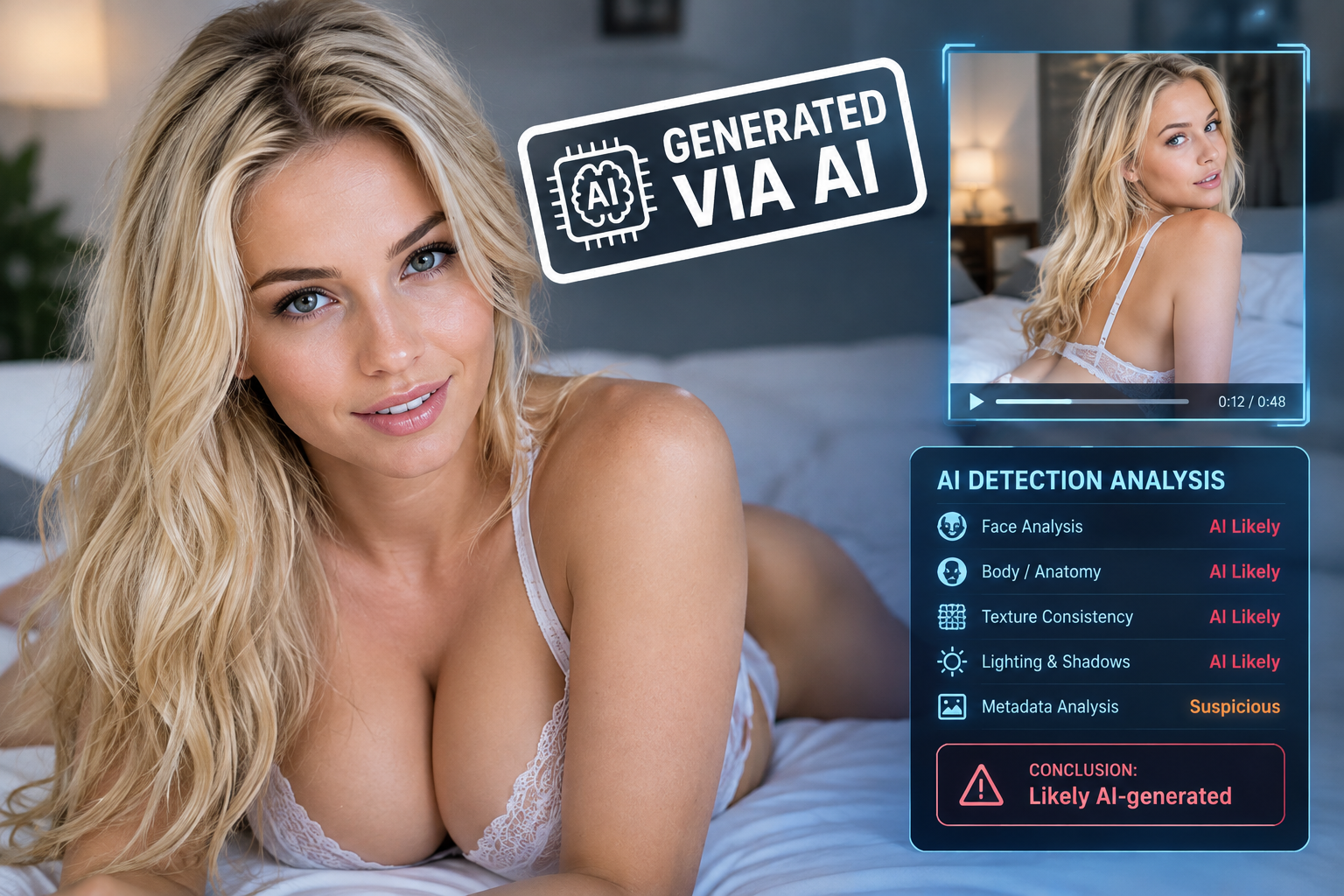
Detecting Whether a Pornographic Image or Video Is Real: How AI Can Help in 2026 Identify Deepfakes and Synthetic Adult Content.
Introduction: The Growing Challenge of Authenticity in Adult Content
The rapid development of artificial intelligence has fundamentally changed how digital images and videos are created, edited, distributed, and consumed. While AI-powered tools offer valuable opportunities for creative production, entertainment, and visual communication, they also introduce serious challenges for online platforms, particularly in the adult entertainment industry.
One of the most important questions facing content moderators, platform operators, publishers, and technology providers is increasingly straightforward: How can we determine whether a pornographic image or video shows authentic recorded material or has been generated, manipulated, or synthetically altered by AI?
The answer is more complicated than it might initially appear. Modern generative AI systems can create highly realistic human faces, bodies, and intimate scenes. Other tools can modify existing photographs, replace faces, alter movements, or combine authentic footage with synthetic elements. Consequently, visual inspection alone may no longer be sufficient to establish whether a piece of adult content is genuine.
For dating platforms, adult websites, creator platforms, online communities, and digital marketplaces, this challenge extends far beyond technology. It involves consent, identity protection, copyright, platform integrity, age assurance, and the prevention of fraud and abuse.
AI-powered image and video analysis can help organizations identify suspicious material, prioritize moderation decisions, and assess the authenticity of digital content. However, reliable detection requires a combination of technical analysis, contextual information, human review, and clearly defined safety policies.
This article explores how organizations can approach the detection of real versus AI-generated pornographic images and videos, which technologies are available, what their limitations are, and why a comprehensive content verification strategy is becoming increasingly important.
What Is the Difference Between Real and AI-Generated Adult Content? Pornographic Image or Video Is Real.
Before examining detection technologies, it is important to distinguish between several types of digital material that may appear similar to viewers.
Authentic photographs and videos
Authentic content generally originates from a camera recording a real scene. However, authentic footage can still be edited, filtered, compressed, or manipulated. A real photograph is not necessarily an unaltered photograph, and authentic footage does not automatically establish that everyone depicted consented to its creation or publication.
AI-generated images and videos
AI-generated material is created partly or entirely by generative models rather than directly captured from a real-world event. These systems can produce realistic-looking people, environments, and intimate scenes that may never have existed.
Some generated people may resemble real individuals without being intended as direct representations of them. Other synthetic images may deliberately imitate recognizable people.
Deepfake content
Deepfakes are synthetic or manipulated media that use AI techniques to imitate, replace, or alter a person's appearance, identity, or sometimes voice. In the adult industry, face-swapping and identity manipulation can be used to create intimate imagery depicting someone who never participated in the underlying scene.
This distinction is especially important when intimate content is distributed without the depicted person's consent.
AI-assisted or digitally manipulated content
A fourth category includes material that combines real recordings with AI-generated elements. For example, a genuine photograph might have a digitally altered face, or a recorded video might contain synthetic frames.
Such hybrid content can be harder to classify because some elements are authentic while others have been changed.
The central challenge: Detecting whether content is real is not a single yes-or-no task. It may require determining how an image was produced, whether it has been manipulated, whether a person has been impersonated, and whether the available evidence supports the content's claimed origin.
Why Detecting Fake Pornographic Images and Videos Matters
The ability to identify synthetic or manipulated adult content has practical implications for several areas of digital safety.
Protecting individuals against non-consensual intimate imagery
One of the most serious risks is the creation and distribution of intimate deepfakes without the consent of the person depicted. Such material can damage reputations, cause emotional distress, facilitate harassment, and be used for extortion.
Automated detection can help platforms identify suspicious uploads and prioritize potentially harmful material for review. When a platform receives a credible report of non-consensual intimate imagery, its response should not depend exclusively on whether an AI detector can prove that the content is synthetic.
The absence of reliable synthetic-media indicators does not demonstrate consent, and an authentic recording can also be distributed without authorization.
Preventing impersonation and fraudulent profiles
Fake profile photographs can undermine trust on dating websites, adult creator platforms, and online communities. Fraudsters may use synthetic portraits or stolen photographs to create misleading identities, attract payments, or manipulate users.
Image authenticity analysis can help identify suspicious profiles, particularly when combined with duplicate-image searches, account behavior analysis, identity verification, and other appropriate risk signals.
Protecting creators and publishers
Professional creators and studios need to understand how their content is being distributed and whether it has been manipulated or falsely attributed to them.
Detection systems can support investigations into unauthorized edits, synthetic impersonations, and suspicious uploads. However, establishing ownership or a copyright violation usually requires additional evidence beyond an AI-generated-content classification.
Maintaining trust in adult platforms
Platform operators need consistent processes for handling genuine content, synthetic material, prohibited content, and potential abuse.
A well-designed moderation strategy can help reduce fraudulent uploads, improve reporting workflows, and support transparent decisions. It should also avoid treating every AI-generated image as inherently harmful: the relevant question depends on platform rules, applicable law, consent, and the way the material is presented.
How AI Image Detection Works
AI-powered image detection systems analyze digital images for patterns that may indicate synthetic generation or manipulation. Unlike a human observer, an automated system can examine large numbers of images consistently and identify statistical signals that are difficult to recognize with the naked eye.
Nevertheless, no single indicator reliably distinguishes every authentic image from every AI-generated image.
Pixel-level and statistical analysis
Generative models can leave subtle statistical patterns in image pixels. Depending on the generation method and subsequent processing, these patterns may differ from those typically found in photographs captured by cameras.
An AI image detector may analyze:
- Local pixel patterns and statistical irregularities.
- Texture distributions and high-frequency image details.
- Repeated patterns or unusual correlations.
- Artifacts associated with particular generation or editing processes.
- Differences between image regions that may suggest compositing or manipulation.
These signals can contribute to an authenticity assessment. However, resizing, cropping, filters, screenshots, and aggressive compression may weaken or alter them.
Facial and anatomical consistency
Some synthetic images contain inconsistencies in facial details, skin texture, reflections, hair, hands, or body contours. AI systems can analyze these regions for unusual patterns.
For adult content, this analysis must be handled carefully. Lighting, camera angles, movement, image compression, and natural anatomical variation can create apparent irregularities in authentic photographs.
A detector should therefore evaluate multiple features rather than flagging an image simply because a face or body appears unusual.
Lighting, shadows, and reflections
Images of real scenes often contain relationships between light sources, shadows, reflections, and surrounding objects. Synthetic generation systems may occasionally produce inconsistencies in these relationships.
AI models can assess whether lighting patterns appear coherent across different parts of an image. Such analysis can provide supporting evidence, but modern generation systems can reproduce lighting convincingly, and real photographs can contain unusual shadows or reflections.
Metadata and file information
Image metadata may include information about the camera, software, editing history, timestamps, and processing tools used to create or modify a file.
Metadata can be useful when it is available and trustworthy. However, it can be removed, altered, or replaced during normal processing. Many platforms strip metadata automatically when users upload images.
Therefore, missing metadata does not prove that an image is AI-generated, and apparently authentic metadata does not prove that an image is genuine.
Detecting AI-Generated Pornographic Videos
Video analysis introduces additional challenges because a video consists of multiple frames that must be evaluated individually and in relation to one another.
An image may appear convincing when viewed as a single frame but reveal inconsistencies when examined over time. Conversely, a short clip may contain too little information to support a confident classification.
Temporal consistency analysis
AI-generated videos may contain subtle changes in facial appearance, body proportions, clothing, or environmental details between frames. These inconsistencies can be difficult to notice during normal playback.
Video detection systems can analyze sequences of frames to identify:
- Unexpected changes in facial features.
- Inconsistent object shapes or body proportions.
- Unnatural transitions between consecutive frames.
- Unstable textures or lighting patterns.
- Visual discontinuities that may indicate manipulation.
These signals are not definitive. Video compression, low frame rates, motion blur, and ordinary editing can produce similar artifacts.
Face-swapping and identity manipulation
Deepfake videos may replace a person's face while retaining the movements and body of another individual. More advanced techniques can manipulate facial expressions, apparent age, or other identity-related characteristics.
A detector can examine facial boundaries, texture transitions, temporal stability, and inconsistencies between facial movement and surrounding visual information.
Where appropriate, platforms may combine this analysis with consent-based reference images or verified creator information. Such comparisons require strong privacy safeguards, a lawful basis, and controls against unauthorized biometric identification.
Audio and audiovisual consistency
When video includes sound, additional signals may help identify manipulation. Examples include discrepancies between visible mouth movements and speech, inconsistent audio characteristics, or indications that an audio track has been synthetically generated.
However, silent adult videos, dubbed content, background music, and legitimate post-production make audio-based analysis unsuitable as a universal test.
The strongest systems treat audio and video as complementary sources of evidence rather than assuming that either one independently proves authenticity.
The Role of Multimodal AI in Content Verification
A modern content verification system can combine multiple types of analysis instead of relying on a single image classifier.
For example, a platform could evaluate a newly uploaded video through a sequence of automated checks:
- File analysis: Inspect available metadata, file properties, and basic technical characteristics.
- Visual analysis: Evaluate sampled frames for possible synthetic generation or manipulation.
- Temporal analysis: Compare consecutive frames to identify inconsistencies over time.
- Contextual analysis: Examine relevant account history, duplicate uploads, and reported impersonation signals.
- Risk assessment: Combine the available evidence into a review priority.
- Human review: Refer ambiguous or high-impact cases to trained moderators.
- Documented decision: Record the outcome and provide an appropriate appeal or escalation process.
This layered approach is more robust than treating a single detector score as a definitive answer.
It also separates different questions that are often confused. A system may estimate that an image is likely synthetic, but that does not establish whether it depicts a real person's likeness, violates a platform rule, or was published without consent.
Similarly, an authentic image can still be fraudulent, unlawfully distributed, or associated with a misleading profile.
AI Content Moderation for Adult Websites and Creator Platforms
For adult platforms, image and video authenticity checks are most useful when integrated into a broader Trust & Safety framework.
A platform may need to distinguish between permitted synthetic content, prohibited impersonation, unauthorized intimate imagery, misleading profile pictures, and content that requires additional age or identity checks.
Automated upload screening
AI moderation tools can screen images and videos when users upload them. Depending on the platform's policies and applicable law, the system may flag suspected synthetic media, known prohibited material, or other content requiring review.
Automated screening can help prioritize large volumes of submissions, particularly when platforms receive more content than human moderators can inspect individually.
Continuous monitoring and repeat-upload detection
A file that has already been reviewed may appear again in a modified form. Cropping, resizing, mirroring, or recompression can make simple file-hash matching ineffective.
Perceptual hashing and visual similarity analysis can help identify related files, while more advanced systems may detect transformed or partially altered material.
These methods are particularly relevant when platforms respond to reports of non-consensual intimate imagery. Matching technology should be combined with secure case management, appropriate access restrictions, and prompt handling of valid removal requests.
Combining moderation with identity verification
Identity verification and content authenticity analysis solve different problems.
Identity verification helps establish whether an account holder has provided evidence supporting a claimed identity. Image and video analysis helps assess whether a particular piece of media may have been generated or manipulated.
Combining these functions can improve risk assessment, but neither substitutes for the other. A verified user can upload manipulated content, while a synthetic image can depict a fictional person without impersonating anyone.
For this reason, adult platforms should define separate workflows for identity verification, age assurance, content authenticity, and consent-related complaints.
Can AI Reliably Distinguish Real Porn from Fake Porn?
Despite significant progress in generative AI detection, no currently available detection method should be treated as infallible.
The rapid evolution of image and video generation creates a technological race. As generative systems improve, they may produce fewer of the visual artifacts that earlier detectors learned to recognize. Detection systems can consequently lose accuracy when applied to unfamiliar generation models or content that has undergone substantial post-processing.
Several factors influence detection reliability.
First, the quality of the source material matters. High-resolution files may contain more useful information than heavily compressed images, although resolution alone does not guarantee a reliable result.
Second, detection models have limitations. A classifier trained primarily on one collection of AI-generated images may perform poorly on material produced by a different model, especially when the content has been edited.
Third, false positives and false negatives are unavoidable risks. A false positive occurs when authentic material is incorrectly flagged as synthetic. A false negative occurs when manipulated or AI-generated material is incorrectly classified as authentic.
Fourth, detector scores require careful interpretation. A model's confidence score is not automatically a calibrated probability that an image is fake. Its meaning depends on the model, its training data, its evaluation conditions, and the prevalence of synthetic content in the environment where it is used.
For these reasons, AI detection should support decisions rather than replace evidence-based investigations.
When a decision could affect someone's reputation, income, safety, or access to a platform, organizations should establish clear thresholds, provide human oversight, and offer appropriate mechanisms for challenging incorrect decisions.
Content Credentials, Watermarks, and Provenance Verification
Visual analysis is only one way to assess authenticity. Another approach is to examine evidence about the origin and processing history of digital media.
Digital watermarks
Some AI-generation systems can embed detectable signals into generated content. If the watermark survives subsequent processing and the relevant detection method is available, it may help identify the content's origin.
However, not every generation system uses watermarks, and some signals may be damaged or removed through transformations. The absence of a watermark is therefore not proof of authenticity.
Content provenance
Standards and technologies such as C2PA can support verifiable records about a file's origin and editing history. When correctly implemented and validated, these records can help establish which processes or tools were involved in producing a piece of media.
Provenance is not the same as a guarantee that the depicted scene is truthful. A file can have valid provenance and still contain misleading content, while genuine material may have no provenance records at all.
Combining provenance with AI detection
The most effective strategy is to treat provenance, watermark detection, and visual analysis as complementary sources of evidence.
For example, a platform might identify a valid generation credential, observe visual signals consistent with synthetic media, and then assess whether the upload complies with its policies.
If the provenance information is absent, the platform can still evaluate other signals. If the evidence conflicts, the case can be escalated for further review rather than automatically classified.
This approach is especially valuable as synthetic media becomes increasingly realistic.
Legal, Ethical, and Privacy Considerations
Detecting AI-generated adult content involves more than technical accuracy. Platforms must also consider the rights of people depicted in images and videos, the privacy of users, and the consequences of automated moderation.
In the European Union, the General Data Protection Regulation (GDPR) may apply to personal data processed during content verification. The legal requirements depend on the specific processing activity, its purpose, and the circumstances involved.
Facial images are not automatically special-category biometric data under the GDPR merely because they contain faces. However, processing facial data through specific technical means for the purpose of uniquely identifying a person can trigger additional biometric-data requirements.
Organizations should assess the lawful basis for processing, data minimization, retention periods, security controls, transparency obligations, and the need for a data protection impact assessment.
The EU AI Act also establishes rules relevant to certain AI-generated and manipulated content, including transparency obligations in specified circumstances. The exact requirements depend on the type of system, its intended use, the content involved, and applicable exceptions.
Platforms should obtain appropriate legal advice rather than assuming that every synthetic image must be labeled in the same way or that every AI detector falls into the same regulatory category.
Ethical implementation is equally important. Automated authenticity checks should not become a justification for unnecessary surveillance, unrestricted biometric profiling, or indefinite retention of intimate material.
Where possible, platforms should analyze only the information necessary for the stated safety purpose, restrict access to sensitive content, and document how moderation decisions are reached.
How Businesses Can Build a Practical Detection Strategy
Organizations seeking to detect fake pornographic images and videos should begin with a clearly defined operational objective.
A dating platform trying to reduce fake profile pictures may require a different approach from an adult creator platform investigating non-consensual deepfakes.
A practical implementation strategy includes the following steps:
- Define the problem. Decide whether the primary objective is to detect AI-generated media, identify manipulated faces, reduce fraudulent profiles, or respond to non-consensual content.
- Select suitable detection technology. Evaluate image classifiers, video analysis, perceptual hashing, watermark detection, and provenance verification according to the use case.
- Test performance on representative data. Include different image qualities, generation methods, video formats, and post-processing conditions.
- Measure false positives and false negatives. Evaluate performance separately for different content categories and relevant operating conditions.
- Introduce human review. Establish escalation procedures for uncertain cases and decisions with significant consequences.
- Protect sensitive information. Limit data access, define retention rules, and establish appropriate security and privacy controls.
- Monitor changing threats. Reassess detection performance as new generative models and manipulation techniques emerge.
- Create transparent enforcement policies. Explain what is prohibited, how suspected manipulation is reviewed, and how users can appeal incorrect decisions.
Regular evaluation is essential. A model that performs well during an initial pilot may become less reliable when exposed to new content-generation techniques or different user populations.
Organizations should therefore treat detection as an ongoing operational capability rather than a one-time software installation.
The Future of AI-Powered Adult Content Verification
The next generation of content verification systems is likely to combine increasingly sophisticated visual analysis with provenance technologies, contextual risk assessment, and improved moderation workflows.
Instead of producing only a binary classification, future systems may provide more useful evidence about the type of manipulation detected, the reliability of available signals, and the additional checks needed before a decision can be made.
For example, a platform may need to distinguish between an entirely synthetic image, a real photograph with a replaced face, a genuine video with altered frames, and authentic content that has simply been compressed or edited.
This distinction can make moderation decisions more precise and reduce unnecessary restrictions on legitimate creators.
At the same time, platforms must prepare for a future in which high-quality synthetic media becomes increasingly difficult to distinguish from authentic recordings using visual evidence alone.
That is why a combination of detection technologies, trusted provenance, identity verification where appropriate, consent-related reporting processes, and trained human moderators will remain important.
Technology should help platforms make better decisions, not create a false impression that authenticity can always be established automatically.
Conclusion: Trust Requires More Than a Realistic Image
Detecting whether a pornographic image or video is real or AI-generated has become a major challenge for adult entertainment platforms, dating services, content publishers, and digital safety teams.
AI-powered image and video detectors can help identify suspicious visual patterns, face manipulation, synthetic generation, and inconsistencies across video frames. Provenance records, watermark detection, identity verification, and contextual moderation signals can provide additional evidence.
However, no single tool can reliably answer every question about authenticity, identity, consent, or legality. A genuine recording can still be distributed without permission, and an AI-generated image is not automatically evidence of fraud or abuse.
The most effective strategy combines multiple technical signals with clearly defined policies, human oversight, privacy safeguards, and appropriate reporting and appeal procedures.
For organizations operating adult websites and creator platforms, investing in robust content verification is an opportunity to improve user safety, protect legitimate creators, reduce impersonation, and strengthen trust in digital services.
Ultimately, the goal is not simply to detect fake pornographic images and videos. It is to create a digital environment in which authenticity can be assessed responsibly, identities are protected, and consent remains central to content moderation.
As AI-generated media continues to evolve, businesses that adopt a flexible, evidence-based approach to content verification will be better positioned to respond to emerging threats while maintaining a fair and trustworthy platform experience.