

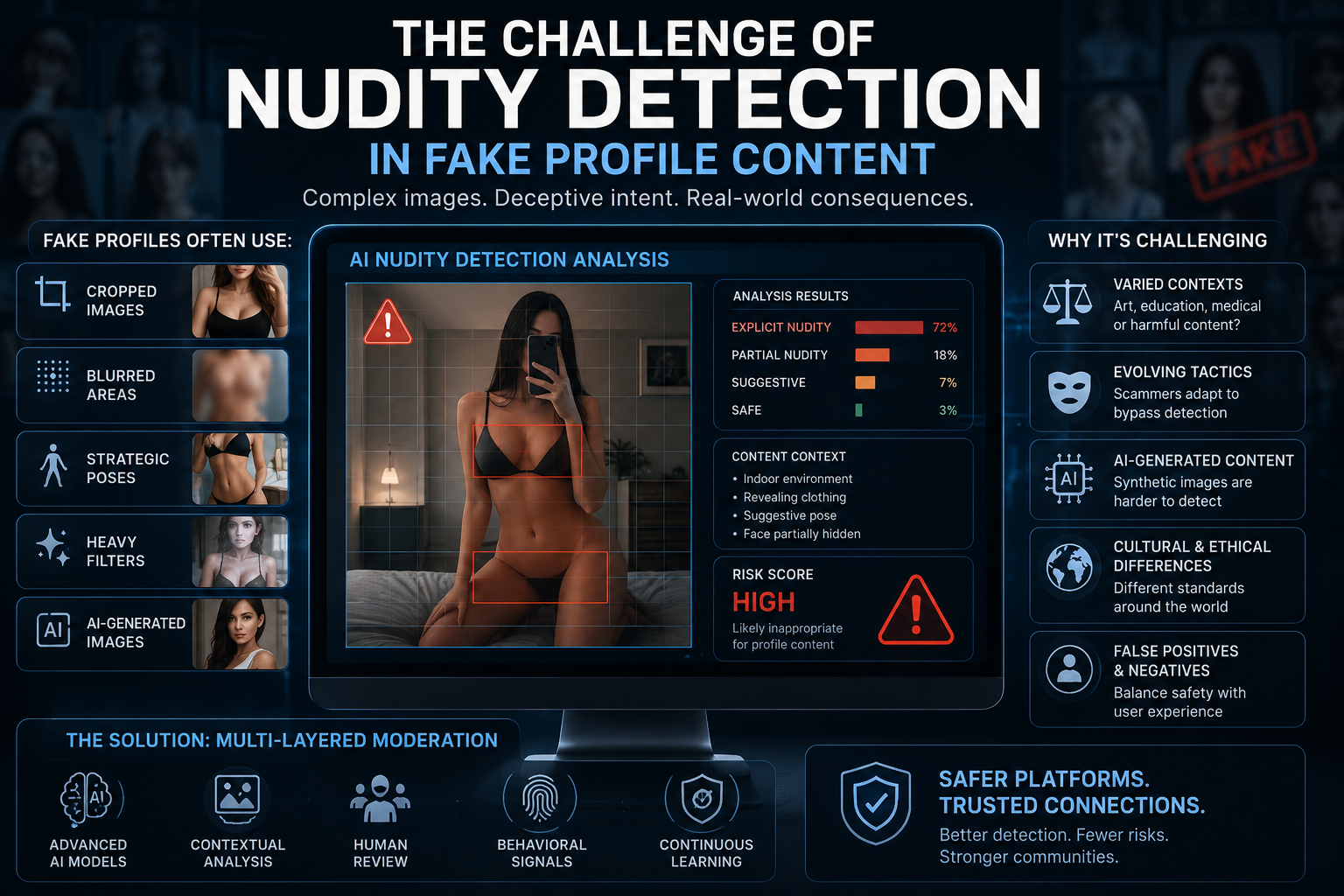
The Challenge of Nudity Detection in Fake Profile Content
The rapid growth of social media, dating platforms, online communities, and user-generated content has transformed the way people interact online. Millions of profile images are uploaded every day, creating opportunities for meaningful connections—but also opening the door to fake profiles, scams, impersonation, and inappropriate content.
One of the most significant technical and ethical challenges facing modern platforms is nudity detection within fake profile content. Detecting explicit imagery is no longer simply about recognizing exposed skin. Today's artificial intelligence systems must distinguish between artistic photography, educational content, medical imagery, manipulated images, AI-generated content, and deliberately deceptive profile pictures.
As cybercriminals increasingly rely on fake identities to deceive users, advanced nudity detection has become a crucial component of comprehensive content moderation. It helps protect users, maintain platform integrity, reduce fraud, and create safer digital environments.
This article explores why nudity detection remains such a difficult problem, how AI-powered moderation systems approach it, and what the future holds for intelligent image moderation.
Why Fake Profiles Are a Growing Problem
Fake profiles have become one of the biggest security concerns across digital platforms. They are commonly used for:
- Romance scams
- Financial fraud
- Catfishing
- Identity theft
- Social engineering
- Cryptocurrency scams
- Spam campaigns
- Malware distribution
Many fake accounts attempt to gain trust by using attractive profile pictures. In some cases, these images contain partial nudity or sexually suggestive content designed to attract attention and encourage interaction.
The challenge for platforms is balancing user safety with freedom of expression while processing millions of uploaded images every day.
Understanding Nudity Detection
Nudity detection refers to the automated identification of explicit or sexually suggestive visual content using machine learning and computer vision.
Modern systems typically classify images into categories such as:
- Safe
- Suggestive
- Partial nudity
- Explicit nudity
- Sexual activity
- Medical content
- Artistic nudity
- Educational imagery
Unlike older rule-based approaches that simply measured skin color percentages, today's AI models analyze the complete visual context.
They consider:
- Human anatomy
- Pose estimation
- Clothing coverage
- Scene context
- Object recognition
- Facial visibility
- Image composition
- Confidence scores
This contextual understanding significantly reduces false positives while improving moderation accuracy.
Why Fake Profile Nudity Is Especially Difficult
Fake profile images introduce unique complexities.
Unlike obvious adult content, profile pictures are often intentionally designed to bypass moderation systems.
Examples include:
- Cropped body parts
- Strategic clothing placement
- Blurred explicit areas
- Heavy image filters
- AI-generated portraits
- Low-resolution uploads
- Mirrors and reflections
- Suggestive poses without actual nudity
Each variation increases the difficulty of automated classification.
Platforms must identify inappropriate imagery without incorrectly removing legitimate user photos.
The Rise of AI-Generated Fake Profiles
Generative AI has fundamentally changed fake profile creation.
High-quality synthetic faces can now be produced within seconds.
These images may include:
- Artificially generated people
- Deepfake faces
- AI-generated influencers
- Synthetic glamour photography
- Computer-generated explicit imagery
Because no real individual exists behind many of these images, traditional identity verification methods become less effective.
Nudity detection systems must therefore analyze not only explicit content but also image authenticity.
Context Matters More Than Skin Detection
Early nudity detection relied heavily on skin exposure ratios. This approach failed in many scenarios.
For example:
A beach photograph naturally contains significant exposed skin or a sports competition may involve minimal clothing. Also medical documentation can contain exposed anatomy and classical artwork often depicts nudity.
Simple skin detection algorithms cannot distinguish these legitimate contexts from explicit adult content.
Modern AI models instead evaluate:
- Human pose
- Body positioning
- Background environment
- Facial expressions
- Scene semantics
- Relationships between objects
Context-aware moderation dramatically improves reliability.
Computer Vision and Deep Learning
Most modern nudity detection systems rely on deep learning. Common technologies include:
Convolutional Neural Networks (CNNs)
CNNs extract visual features from images.
They identify:
- Shapes
- Textures
- Clothing
- Human body parts
- Facial landmarks
CNNs remain highly effective for image classification tasks.
Vision Transformers (ViTs)
Vision Transformers process images similarly to natural language transformers.
Advantages include:
- Better contextual understanding
- Improved long-range feature recognition
- Higher classification accuracy
- Scalability for large datasets
Many state-of-the-art moderation systems now incorporate Vision Transformer architectures.
Multi-Modal AI
Newer moderation models combine:
- Images
- Text
- User metadata
- Behavioral signals
- Historical account activity
This holistic approach improves fake profile detection while reducing moderation errors.
False Positives Remain a Major Challenge
One of the biggest concerns in automated moderation is false positives.
Examples include:
- Fitness selfies
- Swimsuit photography
- Breastfeeding images
- Medical education
- Renaissance paintings
- Indigenous cultural photography
Incorrect removal of legitimate content damages user trust. Platforms therefore aim for high precision alongside high recall.
False Negatives Can Be Equally Harmful
False negatives occur when explicit images remain undetected.
Consequences include:
- Increased user complaints
- Exposure of minors
- Brand reputation damage
- Legal compliance risks
- Higher moderation costs
Finding the right balance between over-moderation and under-moderation remains an ongoing challenge.
The Importance of Human Review
Artificial intelligence should rarely operate alone.
Many moderation systems employ human reviewers for borderline cases.
Typical workflow:
- AI analyzes uploaded images.
- High-confidence decisions are automated.
- Medium-confidence cases enter human review.
- Final decisions improve future model training.
This human-in-the-loop approach continuously enhances model accuracy.
Detecting Manipulated Images
Fake profile creators frequently modify images to bypass filters.
Common techniques include:
- Color alterations
- Compression artifacts
- Image cropping
- Added overlays
- Watermarks
- Artificial blur
- Background replacement
Modern AI moderation systems increasingly use image forensics alongside nudity detection.
These methods help identify manipulation attempts.
AI-Generated Explicit Images
Generative AI tools can now produce highly realistic explicit imagery without involving real people.
These synthetic images introduce new moderation challenges because:
- Traditional reverse image searches fail.
- Metadata is often absent.
- No original source exists.
- Facial recognition provides limited value.
Future moderation systems will require dedicated synthetic image detection capabilities.
Privacy Considerations
Image moderation must also respect user privacy.
Responsible platforms should:
- Minimize data retention.
- Encrypt uploaded images.
- Restrict reviewer access.
- Comply with privacy regulations.
- Maintain transparent moderation policies.
Balancing effective moderation with privacy protection is essential for maintaining user confidence.
Legal and Regulatory Requirements
Different countries apply different standards regarding explicit imagery.
Platforms often need to comply with regulations involving:
- Child safety
- Illegal content removal
- Data privacy
- Platform accountability
- Digital Services legislation
AI moderation systems therefore require configurable policies that can adapt to regional legal requirements.
Why Dataset Quality Determines Success
Even the most sophisticated neural network performs poorly if trained on biased or incomplete datasets.
High-quality datasets should include:
- Multiple ethnicities
- Diverse body types
- Various lighting conditions
- Different camera angles
- Cultural clothing variations
- Multiple age groups (excluding illegal material)
- Real-world image quality
Dataset diversity directly improves fairness and reduces algorithmic bias.
Continuous Learning Improves Accuracy
Online threats evolve constantly.
Scammers quickly adapt to moderation rules.
Therefore, successful nudity detection systems continuously learn from:
- Newly reported images
- Human moderator decisions
- Emerging scam patterns
- AI-generated content
- User feedback
Regular model retraining helps maintain detection performance over time.
Combining Nudity Detection with Fake Profile Analysis
The strongest moderation systems do not analyze images in isolation.
Instead, they combine multiple risk signals.
Examples include:
- Profile creation speed
- Device fingerprinting
- Behavioral analysis
- Geolocation consistency
- Reverse image matching
- Face uniqueness
- Image authenticity
- Nudity probability
This layered approach significantly improves fake profile detection compared to relying on image classification alone.
Ethical Challenges
AI moderation must avoid discrimination while protecting users.
Important ethical considerations include:
- Cultural differences regarding acceptable imagery
- Gender fairness
- Transparency
- Explainable AI
- Appeal mechanisms
- Bias reduction
Responsible moderation balances automation with accountability.
Future Trends in Nudity Detection
Several emerging technologies are expected to reshape content moderation.
These include:
Vision-Language Models
Models capable of understanding both images and text simultaneously can better interpret context.
Synthetic Image Detection
Dedicated AI systems will identify images generated by diffusion models and other generative algorithms.
Federated Learning
Privacy-preserving machine learning enables models to improve without collecting sensitive user data centrally.
Explainable AI
Future moderation systems will provide interpretable reasons for decisions, improving transparency for users and moderators alike.
Real-Time Moderation
Advances in hardware acceleration will allow near-instantaneous analysis of uploaded profile images without sacrificing accuracy.
Best Practices for Online Platforms
Organizations seeking effective nudity detection should adopt a multi-layered strategy:
- Use state-of-the-art deep learning models.
- Combine image analysis with behavioral intelligence.
- Continuously retrain detection models.
- Include human reviewers for uncertain cases.
- Monitor model bias.
- Protect user privacy.
- Maintain transparent moderation policies.
- Provide user appeal mechanisms.
- Regularly audit moderation performance.
- Adapt to evolving regulations.
These practices help platforms maintain safe communities while minimizing unnecessary content removal.
Conclusion
The challenge of nudity detection in fake profile content extends far beyond identifying exposed skin. Modern online platforms must navigate a complex landscape involving AI-generated imagery, sophisticated scams, evolving user behavior, privacy regulations, and cultural differences.
Today's most effective moderation systems rely on advanced computer vision, deep learning, contextual understanding, and human oversight to accurately distinguish between legitimate content and harmful material. Rather than treating nudity detection as an isolated task, leading platforms integrate it into broader fake profile detection strategies that combine image analysis with behavioral signals, authenticity checks, and continuous learning.
As artificial intelligence continues to evolve, both malicious actors and defensive technologies will become increasingly sophisticated. Success will depend on developing adaptable, transparent, and privacy-conscious moderation systems capable of keeping pace with emerging threats while respecting legitimate user expression.
Ultimately, robust nudity detection is not merely a technical feature—it is a foundational element of digital trust. By investing in intelligent, ethical, and context-aware moderation, online platforms can better protect their communities, reduce abuse, and foster safer environments where authentic connections can thrive.