

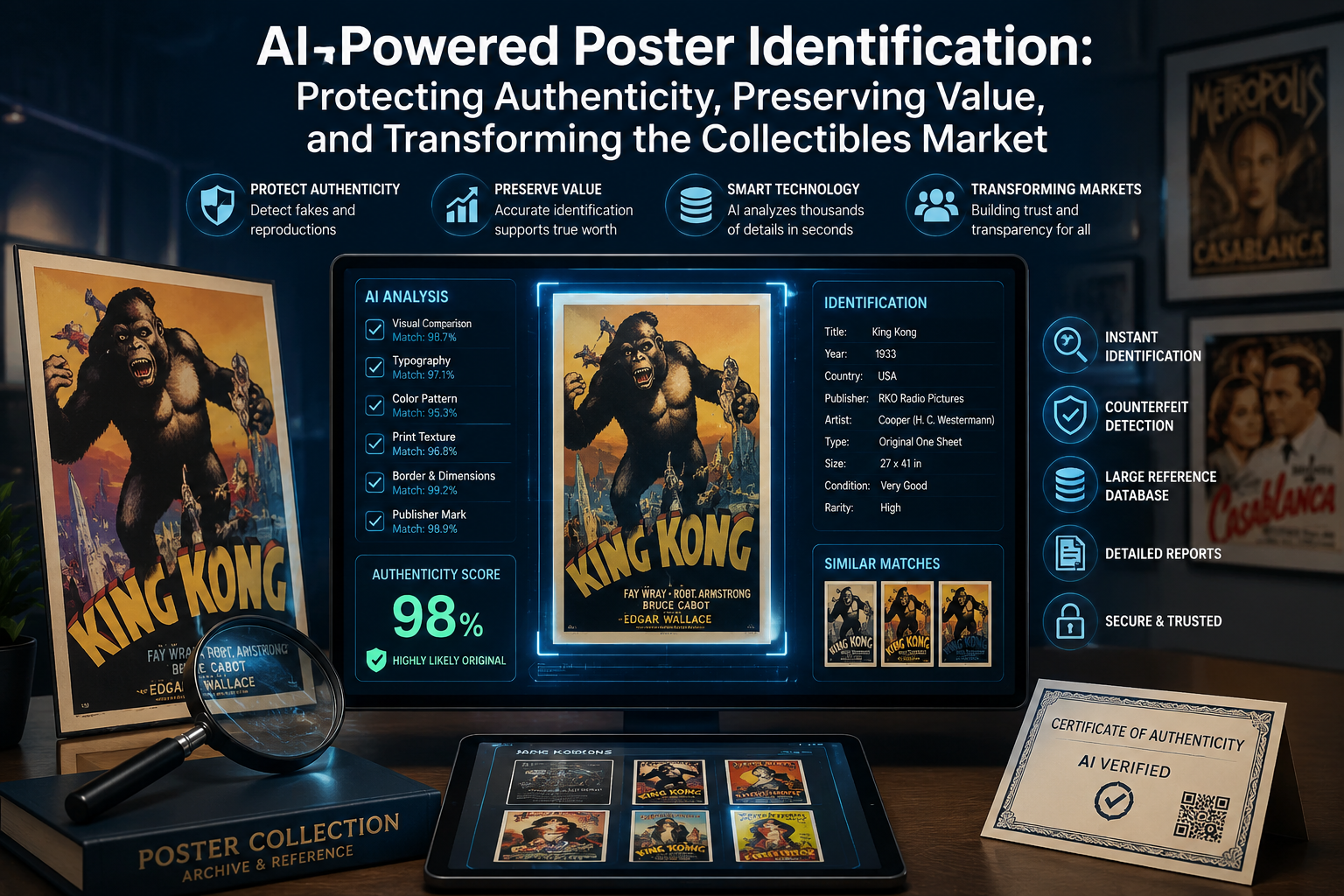
AI-Powered Poster Identification: Protecting Authenticity, Preserving Value, and Transforming the Collectibles Market
Artificial Intelligence is revolutionizing poster authentication, helping collectors, galleries, auction houses, and investors protect the value of original posters while combating counterfeits and misidentifications.
The global market for vintage and collectible posters has experienced remarkable growth over the past decade. Original movie posters, concert prints, travel advertisements, political posters, and limited-edition art prints have become highly sought-after investment assets. As demand increases, so does the risk of counterfeits, reproductions, incorrect cataloging, and accidental misidentification.
Today, artificial intelligence (AI) is emerging as one of the most significant technological innovations in the collectibles industry. AI-powered poster identification enables collectors and professionals to verify, catalog, and preserve valuable posters with unprecedented speed and accuracy. Rather than replacing human expertise, AI enhances authentication workflows by combining computer vision, image recognition, historical databases, and machine learning into an intelligent decision-support system.
As the collectibles market becomes increasingly digital, AI-driven poster identification is helping protect both financial investments and cultural heritage.
The Growing Importance of Poster Authentication
Original posters are far more than decorative artwork. Many represent important moments in cinematic history, music culture, political movements, sports, and advertising. Rare originals can command prices ranging from hundreds to hundreds of thousands of dollars depending on rarity, condition, provenance, and historical significance.
However, determining whether a poster is an original first printing, a later reprint, or an unauthorized reproduction often requires years of experience. Even experts may spend considerable time examining printing techniques, paper characteristics, typography, dimensions, and publisher information.
The increasing availability of high-quality reproductions has made authentication even more challenging. Modern printing technologies allow counterfeit posters to closely resemble originals, making visual inspection alone insufficient in many cases.
This growing complexity has created an ideal environment for artificial intelligence to assist authentication professionals.
How AI Poster Identification Works
Modern AI poster identification systems rely on advanced computer vision algorithms capable of analyzing thousands of visual characteristics simultaneously.
Instead of simply comparing images, AI examines multiple data points, including:
- Typography and font characteristics
- Image composition
- Color distribution
- Printing patterns
- Border dimensions
- Publisher logos
- Copyright information
- Artist signatures
- Fold marks
- Printing imperfections
- Layout consistency
- Paper aging patterns
Machine learning models compare these characteristics against extensive reference databases containing authenticated poster images collected from museums, archives, auction houses, collectors, and historical publications.
Within seconds, AI can identify likely matches while highlighting inconsistencies that deserve further expert review.
Protecting the Value of Original Posters
One of the greatest benefits of AI identification is protecting the long-term value of authentic posters.
Collectors often discover valuable pieces in estate sales, flea markets, antique shops, inherited collections, or private archives. Unfortunately, many posters remain incorrectly identified or completely unknown.
AI significantly reduces this uncertainty by helping determine:
- Whether the poster is likely original
- Estimated production year
- Country of origin
- Publisher
- Printing variation
- Similar authenticated examples
- Historical context
Accurate identification strengthens buyer confidence, improves pricing accuracy, and reduces disputes during private sales or auctions.
For insurance companies, AI-assisted documentation also creates stronger records for valuation purposes.
Fighting Counterfeits in the Collectibles Market
Counterfeit posters represent one of the biggest threats to collectors worldwide.
Fake movie posters, concert prints, and limited-edition art reproductions circulate across online marketplaces every day. Many reproductions are intentionally aged to imitate originals.
AI can detect subtle inconsistencies invisible to the human eye, including:
- Pixel-level image differences
- Incorrect print alignment
- Color deviations
- Font inconsistencies
- Reproduction artifacts
- Digital editing traces
- Modern printing signatures
While AI cannot guarantee authenticity independently, it dramatically improves the detection of suspicious items before they enter the marketplace.
This helps reduce fraud while protecting honest buyers and sellers alike.
AI Supports—Not Replaces—Human Experts
Professional poster authentication remains a highly specialized discipline.
Experienced experts evaluate provenance, printing techniques, historical documentation, paper composition, condition reports, restoration evidence, and many additional factors beyond image recognition.
AI serves as a powerful assistant rather than a replacement.
By automating repetitive comparison tasks, AI allows experts to focus on deeper analysis and final authentication decisions.
This collaborative approach increases efficiency while maintaining professional standards.
Building Comprehensive Digital Poster Archives
Large collections often contain thousands or even tens of thousands of posters.
Museums, galleries, libraries, universities, and private collectors face enormous challenges in cataloging these collections accurately.
AI dramatically accelerates digital archiving by automatically:
- Identifying posters
- Suggesting metadata
- Detecting duplicates
- Classifying genres
- Assigning keywords
- Organizing collections
- Linking related editions
The result is a searchable digital archive that supports research, preservation, exhibitions, and public access.
Digital preservation also protects valuable cultural heritage against loss caused by natural disasters, deterioration, or accidental damage.
Enhancing Online Marketplaces
The rapid growth of online collectibles marketplaces has increased demand for reliable identification tools.
Many buyers purchase posters solely from photographs without physical inspection.
AI-powered identification can improve marketplace trust by assisting sellers in creating more accurate listings while helping buyers verify that images match known originals.
Potential applications include:
- Automated listing verification
- Duplicate detection
- Fraud alerts
- Authenticity confidence scores
- Historical pricing references
- Similar item recommendations
These features increase transparency while reducing the likelihood of disputes.
Faster Insurance Documentation
Insurance providers increasingly require detailed documentation for valuable collections.
Creating inventory records manually can take weeks for large collections.
AI simplifies this process by automatically recognizing posters, generating descriptions, recording dimensions, and attaching reference information.
This enables collectors to maintain up-to-date insurance records while improving claims documentation in the event of theft, fire, or other losses.
Supporting Auction Houses
Auction houses rely on accurate identification and catalog descriptions to maintain buyer confidence.
AI assists catalog specialists by comparing submitted posters with authenticated references, previous auction records, and historical databases.
This allows specialists to:
- Verify catalog information
- Detect possible reproductions
- Identify rare variants
- Improve lot descriptions
- Reduce research time
Ultimately, higher-quality cataloging contributes to stronger auction results and greater market confidence.
Benefits for Private Collectors
Many collectors possess extensive collections accumulated over decades.
Unfortunately, documentation is often incomplete or outdated.
AI-powered identification enables collectors to quickly organize collections while discovering previously overlooked rarities.
Collectors benefit from:
- Faster identification
- Better organization
- Improved collection management
- Easier insurance documentation
- Enhanced resale preparation
- Historical insights
These advantages make AI valuable even for hobby collectors.
Preserving Cultural Heritage
Beyond commercial value, posters serve as important historical documents.
They reflect changing artistic styles, political movements, advertising strategies, entertainment history, and social trends.
Museums and archives increasingly use AI to digitize historical collections while making them accessible to researchers worldwide.
By identifying damaged, faded, or incomplete posters through comparison with archived examples, AI contributes to long-term preservation efforts.
This technology ensures that future generations can continue studying visual culture through well-documented collections.
Machine Learning Improves Continuously
Unlike traditional software, AI systems improve as they process additional data.
Every authenticated poster added to the database helps refine future identifications.
Machine learning algorithms become increasingly accurate when trained on:
- New poster releases
- Rare historical examples
- International editions
- Printing variations
- Regional differences
- Restored examples
- Condition variations
This continuous learning enables AI to recognize increasingly complex distinctions over time.
Integration with Mobile Applications
Modern AI poster identification is no longer limited to desktop software.
Mobile applications allow collectors to photograph posters directly using smartphones.
Within seconds, AI can return:
- Probable identification
- Historical information
- Estimated rarity
- Similar authenticated examples
- Collection management options
This accessibility opens professional-level identification tools to a much broader audience.
Data Security and Privacy
As AI systems analyze valuable collections, data security becomes increasingly important.
Leading identification platforms employ secure cloud infrastructure, encrypted image storage, controlled access permissions, and privacy-focused data management practices.
Collectors remain concerned about protecting confidential information regarding valuable collections.
Responsible AI developers address these concerns through transparent privacy policies and secure technology infrastructure.
Future Innovations
The future of AI-powered poster identification extends well beyond simple image recognition.
Emerging technologies may include:
- Multispectral image analysis
- Paper fiber recognition
- Ink composition analysis
- Blockchain-supported provenance tracking
- Automated restoration recommendations
- Predictive market analysis
- Digital ownership certificates
Combined, these innovations promise an increasingly transparent and trustworthy collectibles ecosystem.
Why AI Matters for the Future of Collectibles
As collectible markets continue expanding internationally, authentication challenges will become increasingly complex.
Artificial intelligence provides scalable solutions capable of supporting collectors, museums, auction houses, insurers, dealers, researchers, and archivists.
By reducing uncertainty, improving documentation, and strengthening authentication processes, AI helps preserve both financial value and historical significance.
Rather than replacing traditional expertise, AI empowers experts with faster analysis, broader data access, and more consistent identification capabilities.
Conclusion
Artificial intelligence is rapidly becoming an indispensable tool in the world of collectible posters. From identifying rare movie posters and vintage travel advertisements to protecting limited-edition art prints from counterfeiting, AI delivers measurable benefits across the entire collectibles ecosystem.
Collectors gain confidence, auction houses improve efficiency, museums enhance preservation efforts, and buyers receive greater transparency. Most importantly, AI helps safeguard the authenticity and value of original posters for future generations.
As machine learning continues to evolve, AI-powered poster identification will play an increasingly central role in preserving cultural heritage while supporting a healthier, more trustworthy collectibles market. Organizations that embrace this technology today position themselves at the forefront of innovation, ensuring that authenticity, provenance, and historical value remain protected in an increasingly digital world.